
Caux Palace Expos 2026
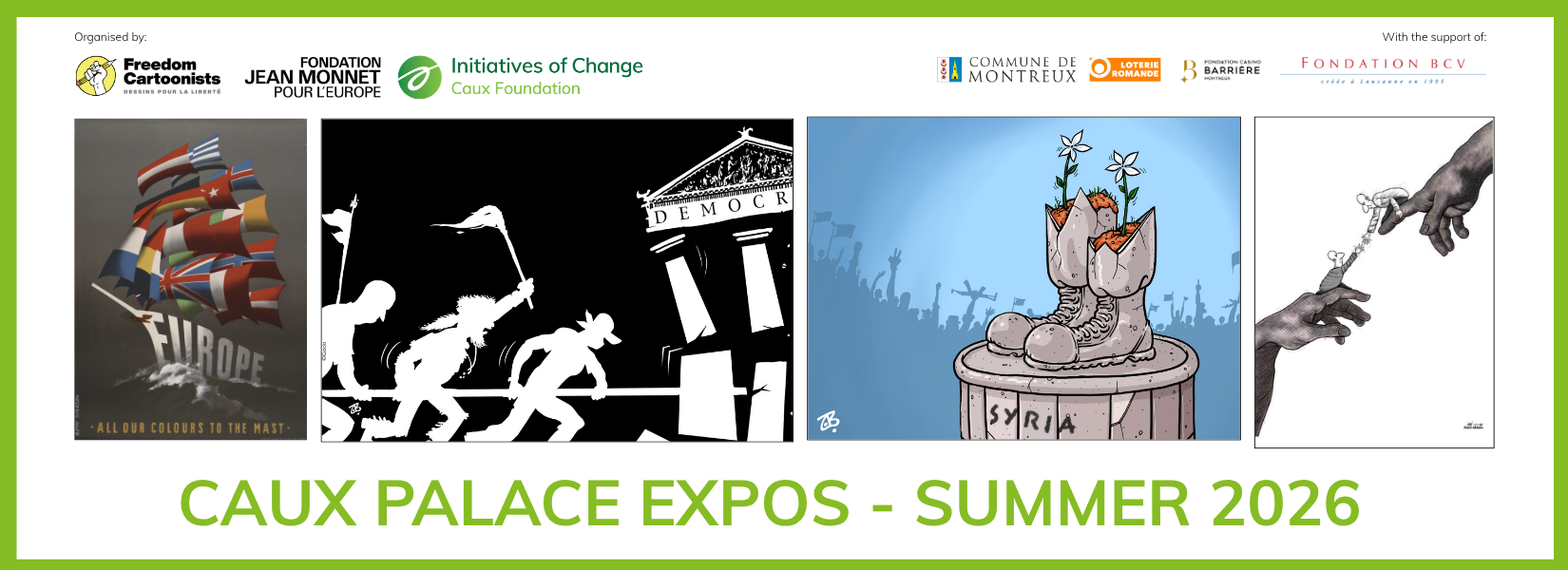
About Caux Palace Expos 2026
True to its long-standing connection with the arts, the Caux Foundation is once again this year highlighting the power of artistic expression to foster understanding, encourage reconciliation and inspire positive social change.
This summer, we are delighted to present two exhibitions that invite visitors to take a sensitive and engaged look at our world: ‘A graphic Europe’, a journey through 80 years of European political history in images, and ‘Drawing to break the silence’, an encounter with the powerful drawings of two leading cartoonists from the Middle East. Two different exhibitions, but a shared dialogue between art, memory and contemporary consciousness.
We warmly invite you to come and discover these two exhibitions and to let yourself be moved by works which, each in their own way, question our times and open up a space for reflection, dialogue and hope.
‘A graphic impression of Europe’
An exhibition tracing 80 years of political posters on Europe
- Venue: The Caux Palace Esplanade
- In collaboration with : Jean Monnet Foundation for Europe
About the exhibition
In 2022, the Jean Monnet Foundation for Europe, based in Lausanne, Switzerland, was contacted by a private collector who was passionate about posters. He had spent his life collecting them, travelli ng the world to hunt down poster art on a huge variety of topics – including Europe. From Greece to Spain, Finland to Malta, he had criss-crossed the continent looking for posters that had some link with the theme of Europe. A few months later, the Foundation acquired a veritable treasure trove: 5,000 posters from the immediate post-war period to the present day. Some promote Europe, others advocate for national sovereignty, but all bear witness to their era, to the most salient issues of the day, and they provide us with an invaluable social and political history in images.
The documents in this exhibition provide us with a singularly graphic impression of Europe. The posters are provocative, funny or simply beautiful , each one designed to capture the attention and convey an instantly understandable message. Expressing solidarity or parochialism,scorn or positi ve messages, whether used for marketing or propaganda, these documents emphasise the complexity of European issues. As the saying goes, “A picture is worth a thousand words”!
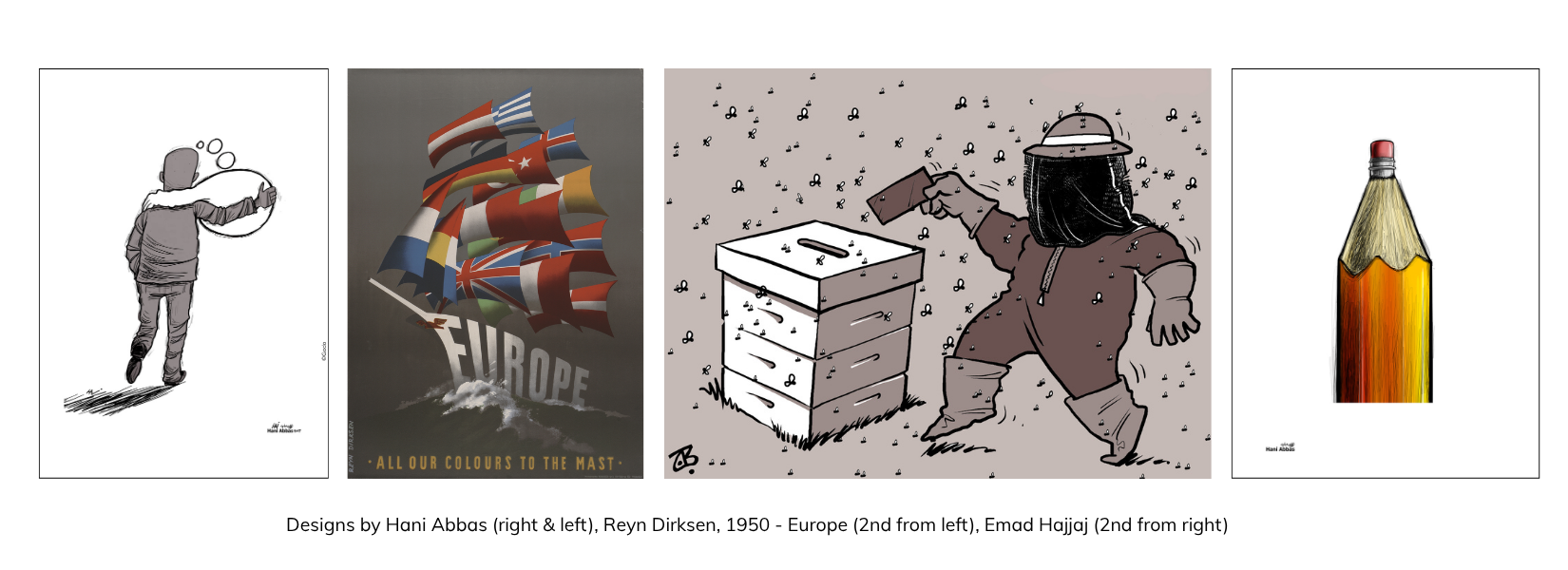
‘Drawing to break the silence’
An exhibition of press cartoons by Hani Abbas and Emad Hajjaj
- Venue: Les Galeries, Caux Palace
- In collaboration with: Fondation Freedom Cartoonists
About the exhibition
After 2025, we continue our initiative to showcase press cartoonists whose work resonates deeply with the themes of our forums: democracy and security issues.
This year, two cartoonists from the Middle East, Hani Abbas and Emad Hajjaj, present their work. The former works in pencil, whilst the latter favours digital tools, each imbuing their drawings with a unique sensibility. Through their lines, they shed light on the complexity of today’s world, examine its tensions and divisions, sometimes offering a scathing or ironic perspective, whilst also opening up prospects for hope and meaning in a world that is losing its bearings.
The artists
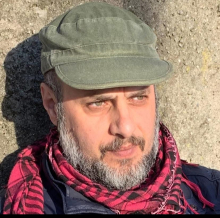
Hani Abbas (Syria/Palestine/Switzerland) is a Syrian-Palestinian cartoonist who has been living in Geneva since 2014, having fled Syria due to threats linked to his political cartoons. In 2012, he settled in Lebanon and was awarded the Freedom of Expression Prize in Doha. On his arrival in Geneva, he was awarded the Editorial Cartoon International Prize by Kofi Annan. His work, published notably in the Swiss and international press, bears witness with great sensitivity to the realities of war, exile and human rights. His cartoons are understated and sharply highlight fundamental issues such as freedom of expression and human rights.
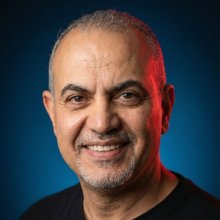
Emad Hajjaj (Jordan/United States) is a political cartoonist currently living in Jordan. His cartoons are published in numerous regional and international Arabic newspapers. He is known throughout the Middle East for his iconic character Abu Mahjoob, created in 1993, who embodies the ordinary Jordanian man facing the political and social realities of his time. A two-time winner of the Dubai Press Award for Best Arab Cartoon, he is listed among the 500 most influential figures in the Arab world by Arabian Business Magazine and notably attended the WEF in 2017. His commitment to freedom of expression has led to several run-ins with the authorities, including an arrest in 2020 for a cartoon criticising the Israel-UAE normalisation agreement, which sparked a wave of international solidarity
_______________________________________________________________________________
Practical information
- OPENING HOURS : Thursday–Sunday, 2 pm–6 pm on the following dates:
- 20 June 2026
- 9–12 July 2026
- 30 July–16 August 2026
- 29 & 30 August 2026
- 12 September (1.00 pm – 6.00 pm)
- 13 September (10.00 am – 6.00 pm)
- Guided tours of the exhibitions (subject to availability): Please contact us
Access
Address: Rue du Panorama 2, 1824 Caux
- Reduced mobility: Wheelchair access and disabled toilets – Find all the details here
- By train: ‘Caux’ stop on the Montreux-Rochers-de-Naye line
- By car: from Montreux: follow signs for ‘Glion - Caux’.
- Parking: Parking spaces are available nearby.
A tip for your journey by car from Lausanne or Vevey: select the route via Clarens or Montreux Gare on your satnav. The ‘Les Avants’ option is a mountain road that is longer and winding and should be avoided.
About the Caux Palace and the Caux Foundation
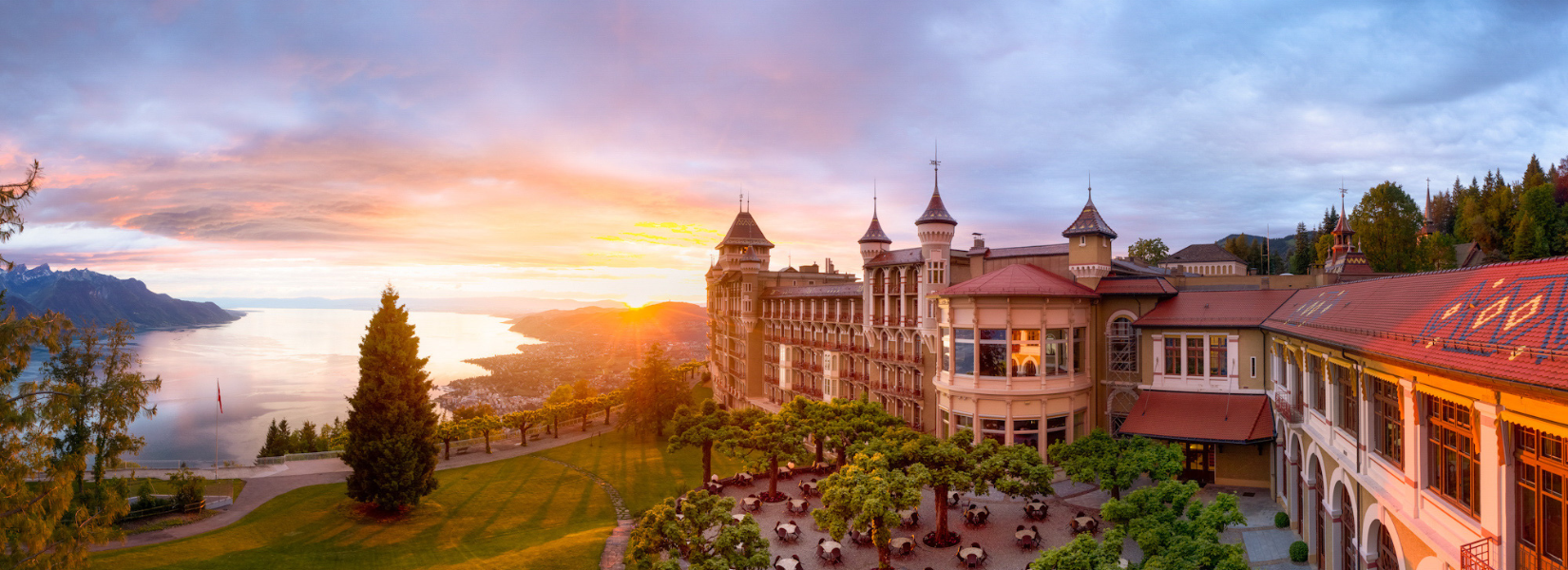
The Caux Palace, recognised as a historic monument of national importance, is a former luxury hotel offering breathtaking views of Lake Geneva and the Alps. Nestled in the mountains, 1,000 metres above Montreux, it was born of the bold vision of the Vaud-based developer Ami Chessex and the renowned architect Eugène Jost, who also designed the Montreux Palace. When it opened in 1902, the Caux Palace was one of the largest and most prestigious luxury hotels in Switzerland.
An iconic landmark of the region, the Caux Palace is built on an impressive historic retaining wall featuring characteristic arches and a 400-metre-long promenade.
In 1946, the building was purchased by 100 Swiss families who wished to transform it into a meeting place for peace and reconciliation in post-war Europe. This vision laid the foundations for the Caux Palace’s enduring role as a centre for dialogue and confidence-building.
Today, the Caux Palace is owned by the private Swiss Caux Foundation. Its mission is to provide a safe and privileged space to inspire, equip and connect individuals, groups and organisations from around the world so that they can engage effectively and innovatively in promoting trust, ethical leadership, sustainable living and human security.
Find out more about our 2026 events
Our Partners
Our summer exhibitions 2026 are co-organised in collaboration with Jean Monnet Foundation for Europe and Fondation Freedom Cartoonists and supported by the Commune de Montreux, the Loterie Romande, the Fondation Casino Barrière de Montreux and the Fondation BVC.

____________________________________________________________________________________________________________
CAUX FORUM EXPOS AT THE CAUX PALACE
"Echos of Reality & Echoes of Hope"
Art works by the artist Daniel HR and by Álvaro Sebastián Quiroz Bolaños (Mexico), social entrepreneur, visual artist, and international advocate for dignity, resilience, and suicide prevention.
"Icons on Ammo Boxes"
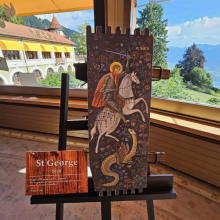
The Caux Democracy Forum was proud to welcome three works from the Ukrainian art project "Icons on Ammo Boxes". Curated by Nataliya Bezbordva and created on ammunition boxes recovered from areas affected by the war in Ukraine, these powerful artworks transform symbols of conflict into symbols of hope, dignity and resilience. They offer a moving reminder of the human cost of war and the importance of defending democratic values, peace and human dignity. Their presence at Caux reflects the Forum’s commitment to dialogue, resilience and the belief that even in times of conflict, humanity can prevail.
"Beyond Words - An Exhibitions on the Trustbuilding Programme"
Works of art created as part of the Caux Foundation's Trustbuilding Programme between January and May 2026.
For several decades now, Initiatives of Change International has been working in conflict zones through its Trustbuilding Program and has proven expertise in this field. In 2026, the Caux Initiatives of Change Foundation launched its own programme in Switzerland, in partnership with the PAIRES association, the artist Audrey Cavelius and the facilitator Hamza Ghandour.
This programme of seven participatory workshops brought together around twenty people, half of whom had a migrant background and the other half of whom were familiar with life in Switzerland, to explore the dynamics of trust together through art and dialogue.
At the end of the project, the presentation of the artwork co-created by the participants is a moving opportunity to discover from the inside a collective process and the transformations it has made possible.
"The Truth will set you free"
A selection of paintings by Swiss-German artist Ulrike Keller
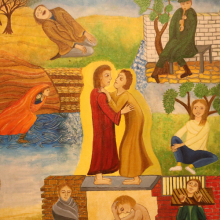
Inspired by the former East-West German border at Point Alpha and by the stories of those who lived under dictatorship, the exhibition explores themes of freedom, suffering, hope and reconciliation. Through a series of deeply personal oil paintings, the artist invites visitors to reflect on their own journeys, the choices that shape their lives, and the paths that lead from division towards freedom and human dignity. At a time when democracy and peace cannot be taken for granted, these works offer a space for reflection, remembrance and hope.
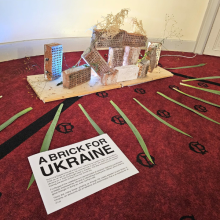
"Follow the Journey - Bricks from Norway and Ukraine"
An arts installation by Sveinung Nygaard