"I hope to inspire others to follow their path with courage."
Interview with musician Farah Erfani, Émergences musicales 2024
26/11/2025As the third edition of Émergences musicales Montreux-Riviera, organised by the Fondation de la Saison Culturelle de Montreux in partnership with the Caux Initiatives of Change Foundation, approaches, the Caux Palace – an iconic venue perched above Montreux between the sky, mountains and Lake Geneva – is once again set to become an extraordinary creative laboratory.
The little sister of the famous ‘Rencontres d'Astaffort’ founded more than thirty years ago by Francis Cabrel in his native village in south-western France, Émergences Musicales and its artistic residency perpetuate the same spirit: to reveal, support and inspire new French-speaking talent.
Each year, nine young French-speaking artists are chosen to perfect their writing, composition and stage presence alongside recognised professionals in an inspiring setting that breaks the solitude of an artist's early days and encourages encounters, particularly through intimate concerts, but also through cultural mediation activities.
It was in this Belle Époque setting that the young Swiss artist Farah Erfani had a life-changing experience in December 2024. The 25-year-old guitarist, author, composer and performer talks to us about her experience at Émergences Musicales 2024 and her artistic journey, between family heritage, the quest for authenticity and an unexpected connection with the Caux Palace.
______________________________________________________________________________________
Farah, tell us about your musical journey and how it has shaped your artistic identity.
Farah: I started playing classical guitar at the age of 10 and studied it in Lucerne, although I also play electric and baroque guitar. At 14, I wrote my first songs in English, but it wasn't until I was 22 that I started writing in French, initially to pass the time on the train when I couldn't practise my instrument. To be honest, I didn't take it very seriously, but I soon noticed that people liked these songs and found them appealing.
Two years ago, I took a year off at the beginning of my master's degree because I wanted to work on and improve my guitar technique. At the same time, I thought it would be fun to develop my songwriting skills. One thing led to another, and without really realising it, I slipped into a professional career in this field. In early 2024, after a break-up, I decided to prepare my first solo concert, ‘Gainsbourg et moi’ (Gainsbourg and Me), and I started composing and arranging Serge's songs.
Your family has a deep connection with Caux. Can you tell us about it?
Farah: Yes, and it's a pretty crazy story that begins before the Second World War and spans two generations. It all started in England with my grandmother and her first husband, John Howard, brother of Peter Howard, a figure in the Initiatives of Change movement in the 1960s. When John died during the war in the Netherlands, a Dutch family who had taken him in, wrote to my grandmother. She decided to go to the Netherlands and met the eldest son of that family... who became my grandfather, and, as they say, ‘the rest is history’. An even more incredible detail: my grandfather was born on exactly the same day as John Howard.
Decades later, my mother discovered a book about Peter Howard. Fascinated, she contacted Initiatives of Change in London and was invited to a conference in Caux. That's where she met my father, and their love story began on the steps in front of the Caux theatre. They married in 1985. So Caux has been part of my story even before I was born.
How did it feel to come to the Caux Palace with this family history, but also as an artist?
Farah: There was a certain magic in discovering the place where my parents met. It was a bit mythical, because I had heard about Caux since I was a child without ever having been there. I retraced their meeting by seeing the benches, corridors and rooms of the Palace.
Caux is where my parents met. During my stay in Caux, I was walking in their footsteps.
In 2024, you were chosen as a young emerging French-speaking artist to come to Caux. What moments from the Émergences Musicales 2024 made the biggest impression on you?
Farah: It's hard to choose, because there were so many, but the most powerful moment was singing the song ‘Les maisons’ as lead singer in front of 400 people, without a guitar, accompanied by a band. I almost always accompany myself. Thanks to this experience, I discovered that I love just to sing - and that, obviously, the audience does too.
How did the residency shape your writing or your vision for your career?
Farah: I feel like this residency helped me understand my style, because I had to confront my artistic universe with others, which allowed me to put my work into perspective.
And in terms of my “career”, meeting and talking to other people who want the same thing helped me understand where I was and what paths were open to me.
Was there a particular project that was born or transformed in Caux?
Farah: Yes, the song ‘Les maisons’ had a profound effect on me personally. I also had an important encounter: Samir Flynn. We come from very different worlds, he from rap, I from classical music, but ‘Les maisons’ brought us together. This song deals precisely with the theme of upheavals, encounters and farewells in life.
This residency helped me understand my style, because I had to confront my artistic universe with others, which allowed me to put my work into perspective.
Speaking of your vision as an artist, what values guide your music and how do they translate into your compositions or performances?
Farah: I think that, fundamentally, I am dissatisfied with the present, both on a personal and societal level. In search of a remedy for this emptiness, I turn to the past and possible futures. Perhaps I am chronically dissatisfied with myself and my surroundings — but not out of negativity, rather out of idealism. So my songs are often tinged with nostalgia for a time I never knew. I'm looking for landmarks, direction, hope... And in the midst of all that, love comes along unexpectedly.
You come from a multicultural family. How have these roots influenced your music and your view of the world?
Farah: I sometimes feel like I come from everywhere and nowhere. My mother is English, my father is Iranian, and I grew up near Lausanne before moving to German-speaking Switzerland at the age of 19.
This whole array of cultures and languages made me realise that our ways of approaching the world are not absolute. On the contrary, if we always stay in the same bubble, we often end up lacking open-mindedness. The same applies to music! The influences of different styles, in my case classical, chanson and rock, complement and reflect each other. And it is perhaps precisely by linking contrasts that we end up discovering ourselves.
Do you think art and music can contribute to social or cultural change?
Farah: Yes, absolutely, because art reflects the energies and ideas of the moment. When you write songs, you put feelings into words.
However, I think that some things are more politically engaged than others. For my part, I very often write without asking myself questions and without planning what my song is going to be about: I work, so to speak, ‘on inspiration’.
I made an exception for ‘Déconnexion’, a song that expresses my unease about a world without connections, because it's a subject that preoccupies and concerns me. It's a very different writing process, but just as rewarding, because you have to find the inspiration of the moment for the idea rather than the idea of the moment for the inspiration.
I am convinced that art can change things, regardless of its source of inspiration.
What do you want to convey to your audience?
Farah: I hope to offer them a moment suspended in time that speaks to them and reflects who they are. I hope to offer a sympathetic hand to their doubts and fears, whether personal or societal, and gently show them my vulnerability so that they know they are not alone, and that in reality, we are all connected by this feeling of loneliness.
Ultimately, I hope to inspire others to courageously follow their own path. This reminds me of a quote by Giacometti: ‘I think the best way for an artist to be revolutionary is to do their work as well as possible.’
I hope to inspire others to follow their path with courage.
Let's talk about the future... what are your plans as an artist and how could places like Caux or events like Émergences musicales contribute to them?
Farah: I am in discussions with a record label at the moment, and working with them would provide me with great support and various professional opportunities. A few weeks ago, I formed my own band and I can't wait to play with them!
We are doing a week-long residency in Tuscany in the spring to prepare the arrangements for my songs. Then, of course, the idea is to go into the studio to record our first album. People often ask me why I'm not on streaming platforms yet: the fact is, I want to do things right, so I'm preparing myself and taking the time I need.
Caux has a truly magical energy and I would love to go back there for a music project if the opportunity arises! As for Les Émergences, I am very grateful to be part of this family; being able to contribute to it would be an honour.
After your experience with Les Émergences Musicales, what advice would you give to young artists?
Farah: Be bold. Have guts. You often don't lose much by trying, and you shouldn't take rejection personally. Send messages to people you don't know to collaborate, organise concerts or residencies yourself (which I did last summer), sign up for lots of springboards... In short, connect with the public and other artists. That's what allows you to move forward, find and even create opportunities!
_________________________________________________________________________________
Did you know? The Caux Palace opens its doors to artists and cultural organisations for creative residencies, subject to availability. With its exceptional location, it is the ideal place to stimulate creativity and recharge your batteries away from the hustle and bustle of everyday life.
Job Offer: Administrative and Accounting Assistant
(50%, based in Caux, Switzerland)
25/11/2025
The Caux Initiatives of Change Foundation is seeking an Administrative and Accounting Assistant for its team in Caux, Switzerland (50% position)
About us
Caux Initiatives and Change is a Swiss public benefit foundation founded in 1946 with the acquisition of the Caux Palace as a centre for dialogue. Our offices are located in Caux and Geneva, where we organise international and local conferences, seminars and retreats. Our flagship event, the Caux Forum, is held every summer in collaboration with the global Initiatives and Change network and its partners. Our mission is to foster exchanges between people of different cultures, backgrounds and beliefs, promoting trust, ethical leadership, sustainable living and human security.
Your role
As an administrative and accounting assistant, you will play an essential role in the smooth running of the foundation. You will provide versatile support to the various departments, particularly in the areas of administration, accounting and organisation. You will ensure proper document management, basic financial monitoring, donation processing and smooth communication between teams. You will also be involved in preparing Foundation Board meetings and will contribute to the overall coordination of internal activities. This varied and dynamic position will allow you to play an active role in the day-to-day running and development of the foundation.
Are you interested? Find out more (in French)
Launch of the Caux Palace Retaining Wall Restoration Project
22/10/2025
The Caux Initiatives of Change Foundation is proud to announce the launch of the restoration of the Caux Palace retaining wall - a major heritage project that will unfold over the next three years.
Recognised as a historic monument of national importance, alongside landmarks such as the Château de Chillon and Lausanne Cathedral, the Caux Palace holds a special place in Switzerland’s architectural heritage. To mark the start of the works, Swiss television RTS featured the project in an episode of its regional news programme Couleurs Locales.
🎥 Watch the feature here
First Phases: 2025
The first steps of the project - phases 0 and 1, running from September to November 2025 - focus on the southern section of the wall.
Where innovation meets tradition
Two key areas define this phase:
-
Stabilising and reinforcing the foundations with an innovative, eco-friendly biocement solution developed by the award-winning local company Medusoil. This choice embodies our commitment to combining heritage preservation with sustainable practices.
🎥 Watch the short video on this solution -
Restoring the historic masonry using early 20th-century techniques and materials to preserve the wall’s authentic appearance. The work is being carried out by Roger Simond SA, specialists in historical renovation who bring exceptional expertise in traditional mortars and stonework. This initial operation will test and validate the repair and consolidation methods that will guide the full restoration.
A commitment to sustainability and heritage
Beyond its structural objectives, this project reflects the Foundation’s mission to safeguard heritage through sustainable action. Environmentally responsible management, efficient use of resources, and respect for traditional craftsmanship are at the heart of this endeavour.
We extend our heartfelt thanks to Loterie Romande, Pro Patria, Ernst Göhner Stiftung, Baer SA, IofC Norden, and our individual donors for their generous support in making this first phase possible.
Help preserve the Caux Palace’s legacy - Your support makes a difference
With nearly one-third of our funding target already reached, we are moving forward with confidence. Every gesture of support - large or small - brings us closer to ensuring this historic landmark can continue to inspire future generations.
🔗 Find out more about the project and how to get involved
Arts and Imagination as Pathways to Peace – Highlights from Geneva Peace Week 2025
22/10/2025
The 12the edition of Geneva Peace Week (13–17 October) brought together thousands of peacebuilders, diplomats, artists, and changemakers under the theme “Peace in Action.” This year, Caux Initiatives of Change was honoured to present three events, exploring how creativity, mindfulness, and the arts can inspire more compassionate and resilient forms of peacebuilding
“Peace in Practice” Workshop: Arts and Mindfulness for a Better World
On 14 October, Caux Initiatives of Change hosted a transformative arts-based workshop led by expressive arts consultant and visual artist Maruee Pahuja (India), and Ines Mokdadi (Tunisia), Global Engagement Events Coordinator at the Caux Foundation. Both are also part of our youth-led Creative Leadership initiative, bringing creativity and empathy to the heart of peacebuilding.
Through movement, silence, drawing, and creative writing, participants explored how imagination and expressive arts can help us reconnect with compassion—for ourselves and for others. From reflective warm-ups like “How would your best friend describe you?” to exercises with light, photography, and poetry, the workshop offered a space to pause, reflect, and rediscover the creative potential at the heart of peacebuilding.
As Maruee reminded participants: “Choose to use life as a medium for peacebuilding: we begin with imagination, we begin with light, we begin with the smallest creature—because even the smallest can carry a revolution.”
The session illuminated how creative expression fosters hope, mindfulness, and resilience, helping us move beyond polarization and reconnect with empathy.
Peace in Motion: Exploring Geopolitical Intersectionality and Public Spaces in Geneva
On Friday, 17 October, Dr. Gal Harmat (swisspeace) and Sarah Noble (Head of Global Engagement at Caux Initiatives of Change) led a thought-provoking geopolitical intersectionality and peace walking tour through Geneva, exploring how public spaces reflect and shape our understanding of peace, gender, and identity.
From Monika Sosnowska’s “Façade” at the Geneva Graduate Institute to the Broken Chair, Place des Nations Fountain, and memorials for Srebrenica and the Genocide against the Tutsi, participants reflected on questions such as:
- Who is represented in public art—and who is missing?
- Whose suffering and resilience are remembered?
- How do gender and social norms influence our urban landscapes?
Dr. Harmat also noted that 96% of public sculptures in Western Europe and North America depict men, while women and queer figures are often faceless or passive - an imbalance that shapes how we perceive both art and peace.
“Peace is small, fragile, and needs resuscitation — and maybe it’s our responsibility to take care of it,” she concluded.
The tour encouraged participants to look at cities—and at peace itself—with renewed awareness, curiosity, and care.
Closing Ceremony: Arts and Peace Encounters – How The Arts Build Bridges
The Closing Ceremony of Geneva Peace Week 2025, organised by the Caux Initiatives of Change Foundation in partnership with the Geneva Peacebuilding Platform, brought together artists, peacebuilders, diplomats, and changemakers to reflect on the role of the arts in peacebuilding.
The event opened with a moving spoken word performance by Maryam Bukar Hassan, whose poetry embodied the courage and imagination at the heart of peace.
Moderator Sarah Noble (Caux Initiatives of Change) emphasized that creativity and culture are lifelines that heal and reimagine peace.
Contributors included:
Léa Baroudi (MARCH Lebanon) shared how former enemies in Tripoli turned from conflict to creation through community theatre, demonstrating that art can break barriers, allowing people to be vulnerable and reconnect with their humanity. More than 700 young men have gone through these programs. Many are now peacebuilders in their own communities.
Artist Álvaro Sebastián Quiroz Bolaños (Brigada 12 | Mexico) highlighted art as a tool for dignity and remembrance, from organizing art auctions to creating "Echoes of Reality" in honour of human rights defenders, showing how art helps to give visibility and dignity to those who are forgotten, and to create spaces for hope.
Indian visual artist Maruee Pahuja reflected on how arts, for the Creative Leadership programmes, have allowed participants to imagine leadership differently - with empathy, curiosity, and playfulness rather than hierarchy and burnout: "Art gives us a language when words are not enough."
Barbara Aebischer (Swiss Development & Cooperation/ FDFA) shared how culture offers people a neutral, creative environment, creating opportunities for discussion, for accountability and for building understanding. Using an example from Mozambique she described how music can be a powerful tool to express resilience, process trauma and share hopes and dreams, bridging divides between communities.
H.E. Ambassador Sabine Bakyono Kanzie (Burkina Faso) explained how cultural traditions like parenté à plaisanterie (“joking kinship”) soften divisions, build trust, and create a common language in diplomacy.
The ceremony came to an end with Naël Melerd’s slam poem “Cœur et Esprit / Heart and Spirit,” a poignant reminder that peace must be guided not only by reason, but by the heart.
In her closing remarks, Dr. Annyssa Bellal, Executive Director of the Geneva Peacebuilding Platform, reflected on the energy and impact of this year’s Geneva Peace Week, noting the participation of over 5000 attendees, 200+ speakers, and 135 organizations across 100+ activities. She thanked the board members, consortium partners, volunteers, staff, and sponsors whose dedication made this inspiring week possible.
Continuing the Journey
Through creative reflection, mindful movement, and artistic dialogue, the Caux Initiatives of Change Foundation’s events at Geneva Peace Week highlighted how imagination and collaboration can bring peace in action to life. Participants were encouraged to carry this spirit forward — and to join the Caux Arts and Peace Encounters (CAPE) 2026 (10–13 May 2026) to continue exploring creativity, compassion, and dialogue.
🔗 Register your interest for CAPE 2026 here
👉 Sign up for our newsletter to stay informed about our upcoming events.
Photos: Eve Brenot, Tina Clifton and Mélanie Lam
Making Room for the Next Generations - Reflection on the Role of Youth from the IDG Summit 2025
By Ignacio Packer, Executive Director, Caux Initiatives of Change
16/10/2025
Stockholm, 15 October 2025
At this year’s Inner Development Goals (IDG) Summit - Bridging Polarities in Stockholm, Ignacio Packer, Executive Director of Caux Initiatives of Change (IofC), joined 800 changemakers from around the globe to explore one of the most pressing questions of our time: How can inner transformation lead to lasting outer change in a world increasingly defined by division?
Ignacio's participation at the Summit reflected the deep alignment between the IDGs and IofC’s core belief — that genuine, sustainable change begins within each of us.
One message at the time in Stockholm stood out clearly: the future depends on the voices and leadership of young people and it is vital that youth are not only included in the conversation but are empowered to lead it.
Ignacio reflects:
________________________________________________________________________
When I was invited to speak at a side event of the IDG Summit 2025 on the question, “What role do young people and the IDGs play in a sustainable future?”, my first reaction was: why me? Looking at my age, I’m hardly the obvious choice to define the role of young people — and certainly not to speak for them.
So I turned to my peers — and to the rooms we still influence — to make the case for creating more space where young people can lead.
That question — who gets to speak, and who gets to make space — has followed me for years. It found particular resonance during this year's IDG Summit under the theme Bridging Polarities, a theme that invites us to hold tension: between experience and emergence, stability and change, the voices that have built the table and those still waiting for a seat.
The Qualities of Being “Young at Heart”
Over the years, I’ve met people who are “young” and “young at heart” at any age. What distinguishes them is their mindset. They keep asking the extra why that reframes a problem. They pivot when context shifts. They see possibility where others see risk. They turn constraints into imagination and ensure the quiet voices are heard.
As Melanie, one of our youth collaborators, wrote to me, young people are “curious, optimistic, inclusive, and full of energy,” and the Inner Development Goals (IDGs) help turn those qualities into wise action — individually and collectively.
Visual artist and Arts Therapy Practitioner Maruee Pahuja from our Creative Leadership initiative for young leaders reminds us that youth bring fluidity over rigidity, challenging cemented narratives and moving us from scarcity mindsets toward the question, “How else can we live together?”
These are precisely the mindsets we need in every room. They map beautifully onto the five dimensions of the IDGs:
- Being: grounded awareness and purpose
- Thinking: reframing problems rather than just solving them
- Relating: empathy and inclusion that amplify quiet voices
- Collaborating: co-creation across differences
- Acting: the courage to prototype, learn, and persevere
Leadership Means Getting Out of the Way
Leadership, in this light, sometimes means getting out of the way. My commitment is simple: I won’t speak for young people, but I will speak as someone determined to make room for them.
That means yielding microphones, seats, budgets, and calendar time. I don’t do that as a gesture — but as my vision of governance.
Space-making is not a favour; it’s a responsibility.
Where Youth Are Already Leading
This form of leadership shows up in many ways at the Caux Initiatives of Change Foundation. In our Reimagining Democracies training programme within the Creative Leadership youth-led initiative, young people are redesigning participation itself.
As Olivia, one of our young contributors, wrote: “The future isn’t set in stone; its magnitude depends on what we do now. The IDGs can be a stepping stone for youth to regain agency — and for older generations, a platform to listen, support, and enable rather than instruct.”
Maruee added, that youth "use creative energies to find newer, smarter, more fun ways.” Their work embodies the IDG path from Relating to Collaborating, turning empathy into shared creation and community.
That, to me, is the new operating system for democracy.
What My Generation Must Transfer
If we’re serious about intergenerational renewal, my generation must transfer three things:
- Trust: real seats, real opportunities, real budgets.
- Access: open our networks, share platforms, and make introductions.
- Protection: manage risk together, allow smart mistakes, and stand beside them when things wobble.
As Olivia reminds us, the IDGs trace a journey from Being to Acting; the role of those of my generation is to remove friction so that journey is possible.
At Caux Initiatives of Change, we strive to make these ideas tangible — to turn intention into practice. The Caux Democracy Forum includes both Reimagining Democracies and a Young Changemakers stream for teens and young adults. Creative Leadership , our initiative for young leaders, builds skills in listening, dialogue, and ethical action. And the Caux Arts and Peace Encounters connect young creators and peacebuilders.
These are not just youth-led or youth-influenced initiatives; they are humanity initiatives that invite all generations to work shoulder to shoulder.
Making Space for Authentic Youth Leadership
As I close, I return to where I began: legitimacy. When I first asked myself why me? the answer was to make space — to remind those of us with titles, tenure, or budget lines that our highest form of leadership may be to step aside and let others lead.
The voices of youth, like that of 22-year-old Violeta Lacroze from Argentina — who moved the Summit audience to its feet in applause — show us what happens when participation is real. It only works when it’s authentic, and hers was. I was also deeply inspired by the presence of a vibrant youth delegation of ten from Argentina whose energy lit up the room.
Renewal doesn’t start “out there” — it starts within each of us, with curiosity, empathy, and the courage to make room for others.
The next generation doesn’t need saving; they need trust, access, and the freedom to lead their own transformation.
Thank you, Violeta, Maruee, Olivia, Mélanie, the Creative Leadership team, the participants of Reimagining Democracy(ies), our Young Changemakers... — and to all young leaders showing us the way forward.
Let’s make more room.
________________________________________________________________________________
Join the IDG journey: Next steps
The IDG Summit was also a wonderful opportunity to connect the dots from this summer’s Caux IDG Forum at the historic Caux Palace in Switzerland — and to look ahead to next year’s gathering.
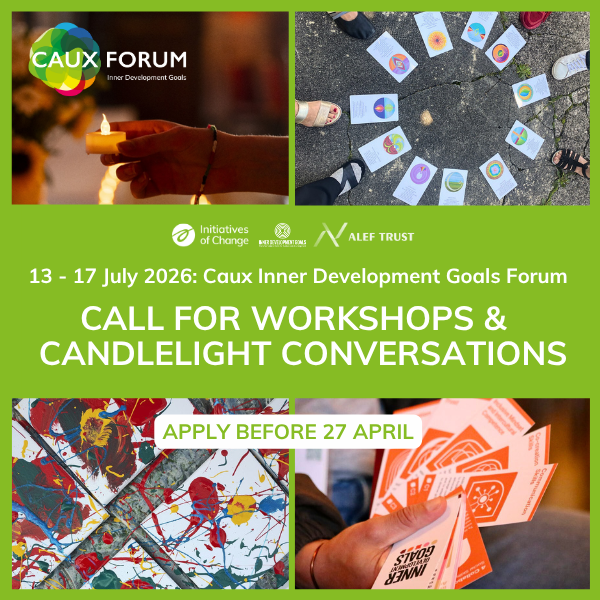
📅 Save the date: Caux IDG Forum | 13–17 July 2026 and get more information: Caux IDG Forum Expression of Interest
________________________________________________________________________________
Ignacio Packer is Executive Director of the Caux Initiatives of Change Foundation, a Swiss private charitable foundation with the mission to provide a safe and privileged space to inspire, equip and connect individuals, groups and organizations from around the globe to engage effectively and innovatively in the promotion of trust, ethical leadership, sustainable living and human security. Ignacio has over 30 years of experience in humanitarian work and development issues. He is an expert on human rights and social issues and has been strongly engaged in global advocacy on protection frameworks for migrants and refugees with a particular focus on children and youth.
David Bondar
David Bondar is originally from the United Kingdom, where he met his Swiss wife before moving to Switzerland in 2010. Passionate about technology, he studied mechanics and computer science, then worked in this field for over twenty years. Outside of his career, he particularly enjoys rowing and motorcycling, and spends part of his free time restoring vintage cars and motorcycles.
"AI won’t save democracy. People will!"
A blog by Ignacio Packer, Executive Director Caux Initiatives of Change
13/10/2025
Stockholm, 13 October 2025
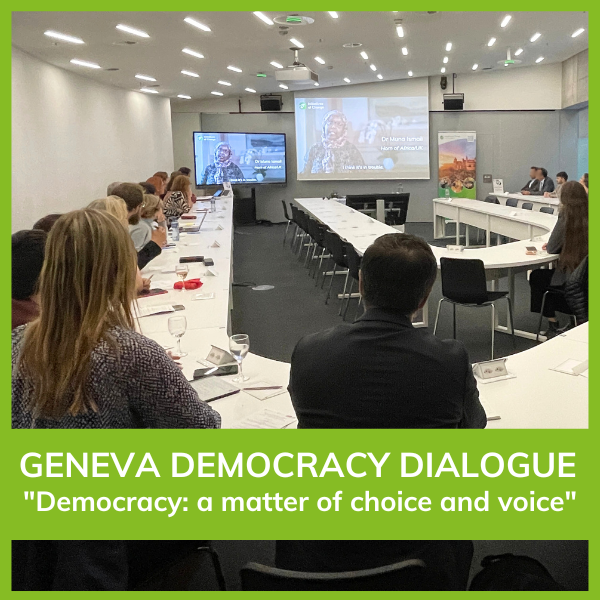
Last Friday at Geneva Democracy Week, we co-hosted an Oxford-style debate on the motion: “This house believes AI can save democracy.” It was inspiring, lively—and ultimately sobering. Because the truth is simple: AI will not save us. Believing it will is not just naïve—it’s dangerous.
At the Caux Palace, our centre for dialogue and trustbuilding above Montreux in Switzerland, we host conversations in a place built for listening. There, I see clearly what can protect democracy:
- Strong, enforceable rules that keep pace with rapidly evolving technology.
- Redesigned incentives—what we reward, promote, or punish—to align private and public interests.
- Investment in people—building the skills, habits, and courage needed for responsible participation.
I’m writing these lines from Stockholm, where the Inner Development Goals (IDG) Summit opens this week. While the Sustainable Development Goals (SDGs) set targets for the world, the IDGs focus on the inner capacities needed to reach them: empathy, critical thinking, courage, resilience.
These capacities matter now more than ever because AI can accelerate both democracy’s strengths and its risks.
The limitations of AI
AI centralizes power; democracy diffuses it. AI can scale manipulation; democracy depends on accountable persuasion.
Algorithms deliver speed where deliberation is needed, and hide decisions behind black boxes where transparency is essential. Social media offered a warning: we were promised greater connectivity, but the result was increased mistrust.
Better tools cannot replace better people.
Skills that sustain democracy
For decades, Initiatives of Change has worked “from the inside out,” cultivating integrity, empathy, courage, and practical collaboration. These inner capacities are the foundation on which rules, audits, and technology can function effectively.
Without them, AI amplifies our worst instincts: outrage over inquiry, shortcuts over responsibility, passivity over participation.
Some of the skills I try to practice personally:
- A learning mindset when answers feel too quick.
- Critical and systemic thinking when claims “sound right.”
- Empathy across difference to understand multiple perspectives.
- Co-creation when complexity exceeds any single expertise.
- Courage to speak truth when it is inconvenient or unpopular.
AI can assist, but it cannot grow these muscles. Democracy depends on humans growing them ourselves.
Testing ideas in public
During Geneva Democracy Week, we put these ideas to the test. At the Maison de la Paix, with the Kofi Annan Foundation, DCAF, Polisync, and EPFL, we debated: “AI is here, but will it be democracy’s saviour or its undoing?”
The conclusion was clear: technology alone cannot save democracy. People, institutions, and communities decide whether it strengthens or erodes it.
Strong AI governance is essential—but rules alone are not enough. Democracy is not a product to download; it is a practice to nurture—within ourselves, in our homes, across communities, and in institutions.
This is the ethos of the Caux Democracy Programme (2024–2027) and its annual forums, where diplomats, civil society leaders, youth, and artists practice listening across divides, honest debate, and shared responsibility—skills that no algorithm can replicate.
Recentering human agency
At the Caux Initiatives of Change Foundation, our vision is a democratic world where people act from responsibility and interdependence. In that world, AI is a transparent, accountable tool that serves human dignity. Today, AI often pulls us away from that vision. The solution is not to reject technology; it is to re-center human agency. For this we need to regulate AI with teeth, redesign incentives, and—most of all—invest in people!
AI will not save democracy. People will. Only citizens who are better trained, better connected, and better grounded can uphold the democratic values we hold dear. People first. Tools second. Then AI can be what it should be: useful.
Democracy can be what it must be: ours!
________________________________________________________________________________
Join the conversation
Stay tuned and join us in shaping the future of democracy. Sign up for our newsletter for updates and registration for the Caux Democracy Forum 2026 (22–26 June) and be part of a community practicing the skills, courage, and dialogue our democracies need.
SIGN UP FOR MORE INFORMATION
________________________________________________________________________________
Ignacio Packer is Executive Director of the Caux Initiatives of Change Foundation, a Swiss private charitable foundation with the mission to provide a safe and privileged space to inspire, equip and connect individuals, groups and organizations from around the globe to engage effectively and innovatively in the promotion of trust, ethical leadership, sustainable living and human security. Ignacio has over 30 years of experience in humanitarian work and development issues. He is an expert on human rights and social issues and has been strongly engaged in global advocacy on protection frameworks for migrants and refugees with a particular focus on children and youth.
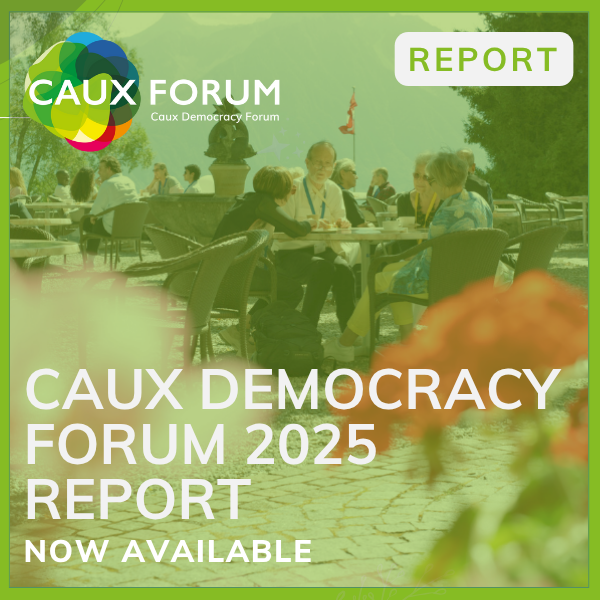
Caux Democracy Forum 2025: The full report is now available
08/10/2025
The Caux Democracy Forum 2025 (8 - 12 July) brought together more than 350 participants from over 45 countries at the Caux Palace to reflect and act on the theme “Revitalizing Democracy – Towards Inclusive and Peaceful Societies Across Europe and the World.”
Grounded in the values of One Humanity, Integrity, Trust, Courage, and Hope, CDF 2025 served as a catalyst for dialogue, collaboration, and moral renewal at a moment of global democratic fragility.