Filling the gap in global efforts for peace and democracy
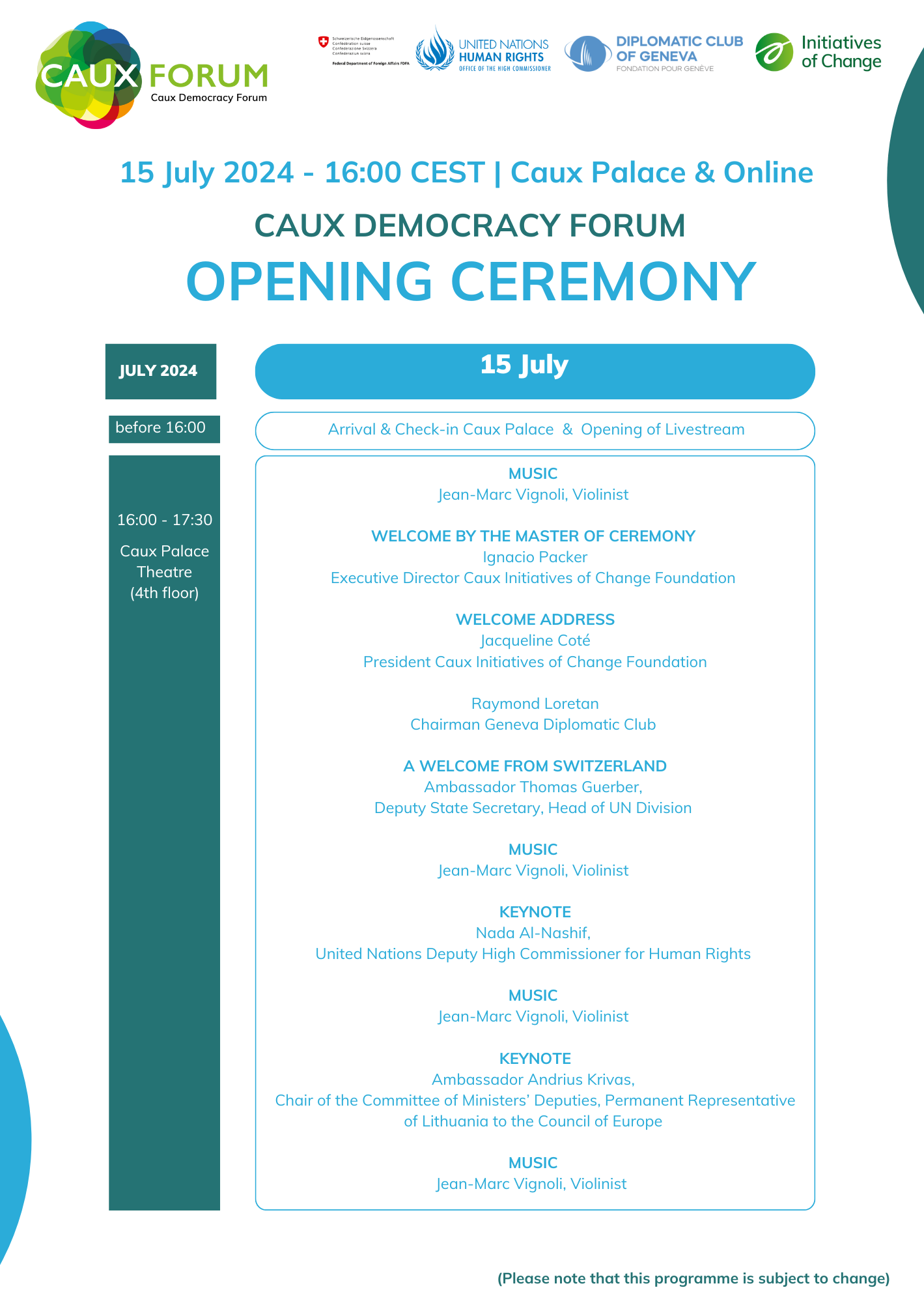
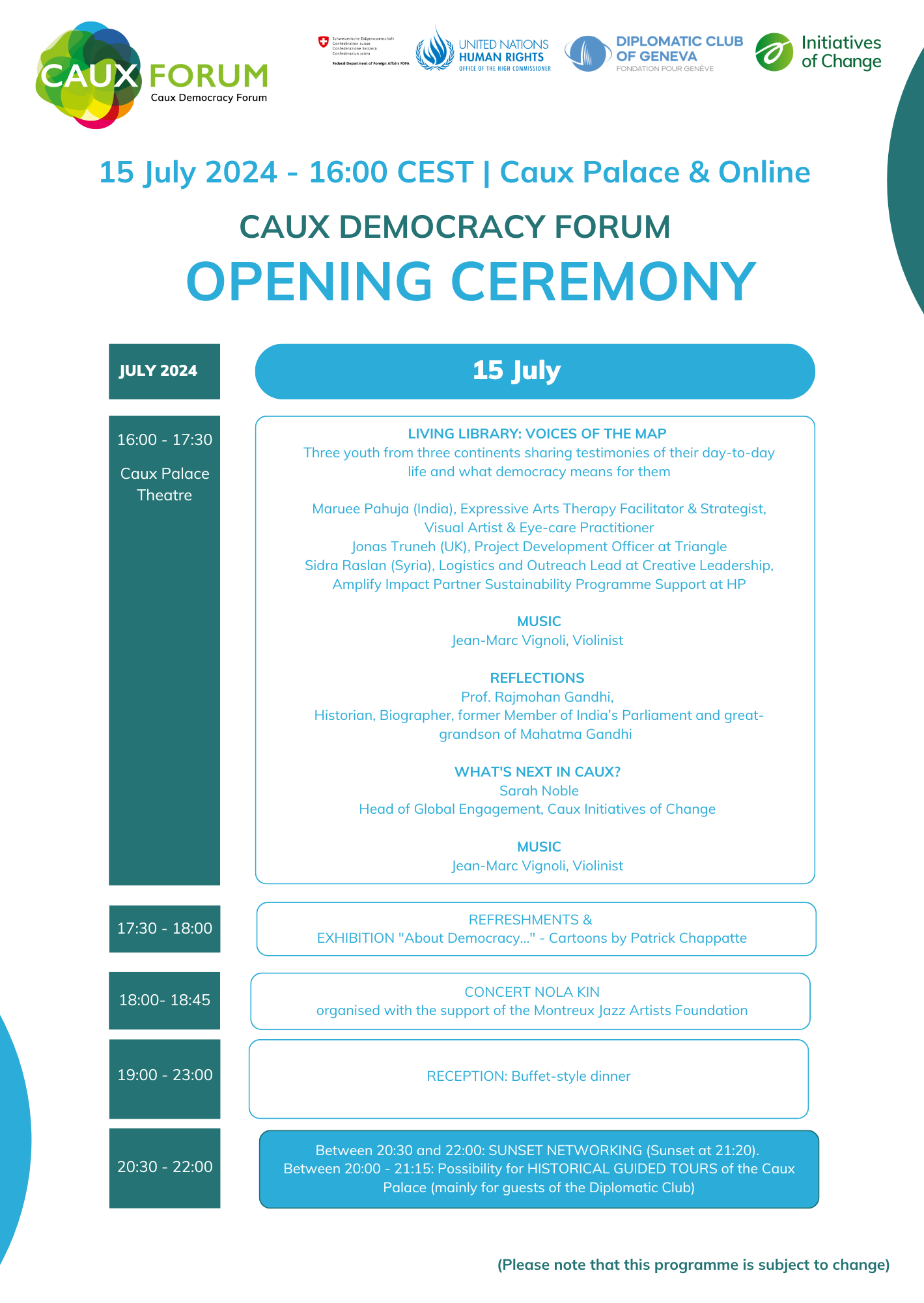
Caux Forum 2023 Opening Ceremony
28/11/2023
The Caux Forum 2023 was an unforgettable experience. It brought together 550 people from 72 countries, representing diverse cultures and sectors, with the aim of inspiring, equipping and connecting participants to build a just, peaceful and sustainable world.
This year’s Caux Forum was especially meaningful as it was the first time convened in person since the onset of the COVID-19 pandemic. New relationships were forged and old ones rekindled within the grounds of the historic Caux Palace. These connections are the very heart of the legacy of Caux. As Taiwan participant Hsu Shoufeng put it, ‘To share concerns with delegates from 72 countries is a reminder of human solidarity.’
The 2023 forum offered a wide range of dialogues and workshops focusing on two pressing themes: Healing the Wounds of the Past and Trust and Integrity in Democracy. Against the backdrop of these themes, Initiatives of Change welcomed expert speakers to the Caux stage, their collective experience and wisdom serving as a foundation for dialogue, ideation and inspiration.
________________________________________________________________________________________________________
‘Caux provides an exceptional setting. It allows us to see beyond political rivalries and polarization. It gives us the space to think, exchange views and develop new lines of action. Caux connects individual and collective action and thus fills a gap in the current landscape of global efforts for peace and democracy.’
Rea Gehring, Minister / Deputy Head of the Peace and Human Rights Division, Swiss Department of Foreign Affairs
The Caux Forum 2023 Opening Ceremony set the tone for the conference with the theme, ‘Strengthening Democracy: The Journey from Trauma to Trust.’
In front of an international audience who had come to Caux or joined online from more than 70 countries, IofC International President Gerald Pillay, kicked off the ceremony with reference to the state of the world, growing threats to democracy and the devastating conflict in Ukraine: ‘War never brings real victories, it only hurts and brings violence and hatred to the next generations. As a team, how can we collaborate to march for world peace? Can we be the symbol for a new peacemaker or changemaker to the global community?’
Jacqueline Coté, President of Caux Initiatives of Change, highlighted how climate change, population displacement, scarcity of public goods and pandemics, coupled with conflicts in many parts of the world, have shown that we are all interconnected. She went on to stress the significant impact Initiatives of Change can have: ‘We bring you down to the individual level, a level that is within each person’s reach. Change starts with oneself. If this is internalized, change will happen in the family, the community, the country, the region and end up influencing the global agenda.’
The opening ceremony also featured Rea Gehring, Minister and Deputy Head of the Peace and Human Rights Division of the Federal Department of Foreign Affairs. ‘Caux is a unique place,’ said Ms Gehring when she addressed the audience. ‘Initiatives of Change has established a diverse and creative platform to explore how we can optimize collective action through our individual efforts. This year's theme couldn't be timelier.’ At a time when ‘division and a lack of trust between people have grown deeper’, Ms Gehring also stressed the importance of constant dialogue to make democracy work. "Caux provides an exceptional setting. It allows us to see beyond political rivalries and polarization. It gives us the space to think, exchange views and develop new lines of action. Caux connects individual and collective action and thus fills a gap in the current landscape of global efforts for peace and democracy."
As in previous years, the Federal Department of Foreign Affairs had brought delegations from several African countries to the Caux Forum and we are grateful for our collaboration with the FDFA which has been going strong for more than 15 years.
The ceremony’s keynote speaker was Elena Zhemkova, the Co-founder and Executive Director of Memorial, a Russian human rights organization shut down by the Russian Government in 2021. Memorial was awarded the Nobel Peace Prize in 2022, along with Ales Bialiatski of Belarus and the Centre for Civil Liberties in Ukraine.
Ms Zhemkova described honesty as ‘a tool for healing historical wounds’ and spoke about her experience in implementing that tool, and the challenges it represents. Describing the origins of her work with Memorial, she openly questioned why it had taken her so long before she began to dig deeper and learn more about the victims of repression in her country. "Did I really know nothing? Or did I not want to know?"
In the face of difficult situations, she encouraged the audience to find new ways to reclaim the truth about the past and create ‘a future that upholds the principle of non-violence, respect for human rights and the importance of every human life in human history.’ In a reference to Caux, she concluded with the image of climbing a mountain and the hope that, even though the peak might not be reached, everybody can make a contribution: "Peace is at the centre of everything!"
Ignacio Packer, Executive Director of Caux Initiatives of Change, then moderated a panel discussion with Elena Zhemkova, Mô Bleeker, Independent Senior Advisor and former Special Envoy for Peace and Prevention of Atrocities for the Swiss Federal Department of Foreign Affairs, and Corinne Momal-Vanian, Executive Director of the Kofi Annan Foundation.
Mô Bleeker stressed the importance of dealing with the legacy of conflicts and atrocities through acknowledging what has happened and taking responsibility to address the consequences. ‘If we seriously wish to engage in healing the wounds of the past, the how is as important as the what,’ she explained. ‘In today's world the constructive management of diversity is not only a challenge but also one of our greatest opportunities.’
She concluded by sharing a quote from the preamble of the Swiss Constitution: “Let’s all together commit to promote a world where the strength of our global community is measured by the well-being of its weakest members,” and by calling on the audience to be “courageous, ethical and creative”.
Corinne Momal-Vanian emphasized the role of youth and urged the audience to remember that the same young people set aside when peace agreements are negotiated will probably be the ones implementing them. ‘Young people, better than politicians, have a capacity to envision the future. They are able to project themselves and they must. They have a key ability to play an important role in reconciliation efforts.’, she explained in her passionate speech and underlined the importance of making young people aware of ethical frameworks, enabling leaders to make just decisions, to take responsibility for mistakes and to put people back into the centre.
The arts have always played an important part in conveying Initiatives of Change's message and Norwegian musician Sveinung Nygaard added an artistic touch by performing one of his compositions. The Opening Ceremony was wrapped up by Nick Foster from the United Kingdom, thanking the audience and the speakers.
We are grateful for this summer and the many enriching moments with those who came to Caux. Colorful, diverse, creative, inspiring - the 2023 Caux Forum was the perfect proof that we are all connected, wherever we come from and whoever we are. As one participant summed it up:
This is what I dream humanity could be about: people being patient with each other, people appreciating the diversity we have.
________________________________________________________________________________________________________
Discover the full Caux Forum 2023 highlights report
Watch the full replay of the Opening Ceremony on our YouTube channel
Denys Smyshliaiev
Denys Smyschliaiev is originally from Ukraine, where he was born and raised. Before moving to Switzerland in August 2023, he worked as a technician and administrative employee at a sports school run by his father. There, he was involved in organising championships and various technical and organisational projects.
In his spare time, Denys enjoys sports and the outdoors: he likes swimming, snowboarding, walking in the forest and mushroom picking. He also enjoys travelling and discovering new places with his family.
Abderrazak Rabouz
Abderrazak Rabouz was born in Morocco and arrived in Switzerland in 2010. His first job was as a multi-skilled worker and sanitary fitter in a renovation company in the canton of Vaud where he worked from 2020 to November 2023. Abderrazak enjoys football and has a passion for oriental cuisine.
Congratulations to Montreux, designated UNESCO City of Music
A wonderful promotion for the arts, youth and sustainablity
09/11/2023
Congratulations to the city of Montreux, which has been awarded the prestigious label of UNESCO City of Music and is now Switzerland's first UNESCO Creative City, along with Fribourg, which becomes City of Gastronomy.
We commend Montreux for its outstanding efforts in uniting various cultural stakeholders in the realm of music, resulting in a vibrant tapestry of musical diversity, spanning genres such as jazz, classical, electronic, and a myriad of cultural contributors in the region.
We are delighted to be partnering with the Saison Culturelle de Montreux on the Emergences Musicales programme in December and look forward to welcoming both artists and audiences at our centre, the historic Caux Palace, nestled high above Montreux, a venue steeped in rich artistic heritage. Our local roots are important to us and, as part of the municipality of Montreux, we are dedicated to utilizing our various spaces, including the theatre, event spaces, and the picturesque gardens, to contribute to the deployment of this important designation.
"In a time when our world faces immense global and human challenges, the need for places of solace, contemplation, and the exploration of potential futures is paramount. Initiatives that allow us to recharge and reflect are indispensable. Caux Initiatives of Change enthusiastically anticipates an enriching partnership with Montreux to enhance and strengthen the offerings, guided by our core principles, as we collectively work towards a sustainable future." says Anne-Catherine Sutermeister, responsible for Community Engagement, Arts and Training Programmes at Caux Initiatives of Change.
- Discover the Caux Palace and its possibilities and offers for cultural and musical events
- Find out more about our concept of Hospitality for Change
Photo top: Adrien Giovannelli
Anne-Catherine Sutermeister
Anne-Catherine Sutermeister has worked in the cultural sector for more than 25 years. She worked in cultural organisations (Théâtre de Vidy-Lausanne, Bibliothèque cantonale universitaire, Théâtre du Jorat), in higher education (La Manufacture in Lausanne and HEAD-Geneva), in cultural policy (Canton of Berne, Pro Helvetia Foundation Board, State of Valais), and as a consultant and trainer (MAS in cultural management at the University of Lausanne/Geneva), which gives her a global view of the cultural sector.
Have we forgotten the path to peace?
A blog by Ignacio Packer, Executive Director Caux Initiatives of Change
03/11/2023
Geneva Peace Week is a leading annual forum in the international peacebuilding calendar and provides a platform to share and exchange knowledge and best practices on a diverse range of topics related to peacebuilding and conflict resolution.
With 64 events in 3 thematic tracks, the 2023 edition of Geneva Peace Week (30 Oct - 3 Nov 2023) celebrated the forum's 10th anniversary and brought together 224 speakers and 3.000+ participants from all over the globe on the theme "Building Trust, Building Peace: An Agenda for the Future",
It has been an honour to have been part of this anniversary edition, represented by our Executive Director, Ignacio Packer, who moderated a workshop on 2 November on how to increase our collective abilities to face complex challenges and promote peace and inclusive societies. Additionally Daniel Clements, Programme Manager of Creative Leadership, participated as a speaker and facilitator and also co-moderated the PeaceTalks event on 1 November.
But once the curtains are drawn and the week is over - where do we go from here? Against the backdrop of current geopolitical realities, Ignacio Packer reflects on a week rich with emotions but also full of inspiring initiatives, encouraging stories, cooperation, hope and new possibilities.
__________________________________________________________________________________________________________________________
When I look at today's realities, I somehow can't help but feel that we have ignored some basic principles that should be applied to the prevention or resolution of all conflicts: the eight core principles of peace which are the foundation of the Peacemaking Covenant! As a result, this has created a peacemaking vacuum that is most often filled by powerful nations concentrating their attention on the conflicts which affect them rather than looking at the global picture.
We tend to sidestep the time-tested premise of negotiation, a crucial element in preventing the deterioration of a bad situation and at the very least offering the potential of a bloodless solution.
The silence and the inaction of many powerful leaders today constitutes the complicity in the senseless and excessively brutal destruction of civilian life. Across the globe, the ongoing nightmares for many pose also a threat to us all. Is it possible that we have forgotten the path to peace?
During Geneva Peace Week 2023, organized by the Geneva Peacebuilding Platform in collaboration with its partners, we reflected on how to strengthen trust, foster cooperation and pave the way for a more peaceful future.
Last week was not only a unique opportunity to reflect on the peacebuilding achievements and setbacks of the past. I am deeply grateful for the possibility to exchange with others and for the stories and best practices which were shared. It is good to know we are not alone in our peace efforts and we need to benefit from existing initiatives and skills. These fresh insights and concrete and bold recommendations coming out of Geneva Peace Week will hopefully pave the way for a strong Agenda for the Future and enable us to address current issues more effectively, to build trust, wherever we are, and to shape a New Agenda for Peace.
Ambassador Patricia Danzi, Director-General of the Swiss Development Cooperation (FDFA), said at Geneva Peace Week: 'We should talk about peace every day of the year." Initiatives of Change believes that each person has something unique to contribute to building a just, peaceful and sustainable world. As a people’s movement with a track record of more than 75 years in peacebuilding and reconciliation, we therefore focus on the vital link between personal change and global change, and we aim to inspire, support and equip people and organisations to help them play their part in building a better society.
This is our contribution to (re)building trust across our world's divides as the core foundation for sustainable peace - at Geneva Peace Week and throughout the year. Together, every day of the year, let us advance step by step along the path to peace that the world so urgently needs!
__________________________________________________________________________________________________________________________
Ignacio Packer is the Executive Director of the Caux Initiatives of Change Foundation. He has over 30 years of experience in humanitarian work and development issues, is an expert on human rights and social issues and has been strongly engaged in global advocacy on protection frameworks for migrant and refugees with a particular focus on children and youth.
Connecting people through music
Maria de la Paz in concert at the Caux Palace
17/10/2023
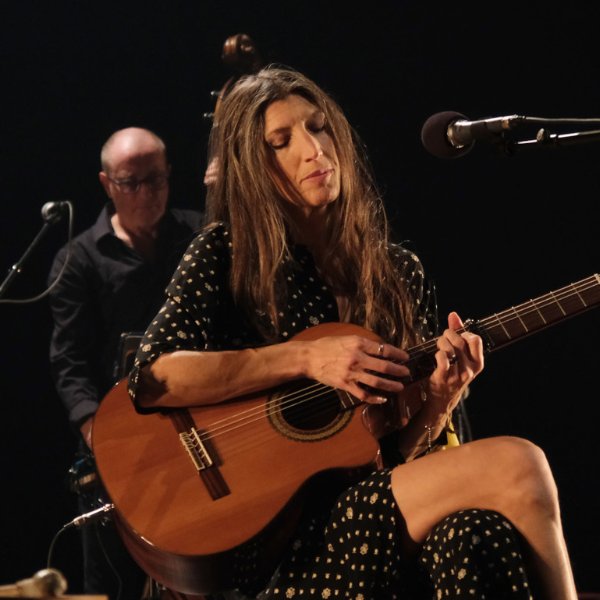
Captivating songs in three languages. An exceptional venue. And an international audience from all walks of life. When Maria de la Paz and her talented musicians stepped onto the stage of the Caux Palace theatre on 13 September, their performance left no-one indifferent.
Their songs, performed in front of more than 300 people, including representatives from the humanitarian sector, local cultural associations and refugees, spoke of hope, passion, shared values and humanity, transcending differences in our backgrounds and origins. The concert was the highlight of an evening, organized by Caux Initiatives of Change, that included speeches from UNHCR and the Swiss association PAIRES, on the concept of hospitality for change and the support and inclusion of migrants (read more about our collaboration).
Turning points
When you see Maria de la Paz's performance on stage and look at her boundless energy and charisma, it is hard to believe that being a musician didn't come naturally to her. Born in Argentina as the youngest of 7 brothers and sisters, she left for Europe when she was twenty-two years old. At the time, she was still searching for herself, trying to find her place in life. Switzerland became an anchor point in her travels. She started working as a street musician, but initially was even too shy to look at the people around her. One day a man stopped and said: "You sing very well...but we can't really hear you"!
It was one of the turning points in her life and Maria de la Paz is convinced that there were specific moments and encounters with people - some seemingly random, others more obvious - which have made a big impact on her as a person and as a musician: "I sensed that life was sending me signals, indicating that there was a purpose I could fulfill. It gave me a direction to explore. When I sing, I see those appreciative looks and hear people saying 'Thank you,' and I respond with, 'No, thank YOU!' Finally I felt genuinely valuable in this world."
Looking for the spark
To this day, Maria de la Paz still likes to perform in a setting that allows her to be close to her audience, such as an unplugged concert or a festival, because she feels that the natural connection to the people around her is a deeply enriching experience. And it is this search to bring people together, to touch them through her music, that lies at the heart of her work as an artist today: "When I feel that I have something to give to people, my self-confidence settles in. I feel love, a feeling that gets stronger and stronger and this is where I find freedom. When you are on stage you have this need as an artist to feel that you have something to give. And if I feel that there could be an opening, a spark, a reflection, or just a feeling of well-being in the audience - I am very grateful!"
The spark was definitely there during her concert at the Caux Palace theatre where she captivated the audience with the poetic melodies and texts of the late artist Lhasa de Sela.
For Maria de la Paz, Lhasa's legacy endures through her songs that speak about life, about the other, about oneself and the human condition: "The show existed already but it was funny how it fit the occasion of the concert in Caux. We didn't change anything and I felt it was very coherent (with the theme of the evening). As the concert went along, I felt there was a logic in the reactions of the audience. This is beautiful because it makes you realize that we are not alone and there is so much to do."
And she concludes: "Humanity has always been like that, full of contradictions and contrast. But rather than succumbing to feelings of frustration and helplessness, I harness my creativity to confront these issues through my music. But I try not to empty myself too much by a feeling of rage and helplessness. And so I fill myself with what I can do."
Reconnecting the past to the future
At Initiatives of Change, the arts have always played an important role in connecting people and in creating bridges across our world's divides. Our concept of Hospitality for Change is not only about providing the best possible welcome and service at the Caux Palace, but also about recognising the power of artistic expression to promote understanding, reconciliation and positive social change and the message of Maria de la Paz’s concert fully aligned with these values. We are therefore delighted that the Caux Palace theatre continues to serve this purpose and look forward to offering more inspiring events.
When you are on stage you have this need as an artist to feel that you have something to give. And if I feel that there could be an opening, a spark, a reflection, or just a feeling of well-being in the audience - I am very grateful!
Maria de la Paz
By Ulrike Ott Chanu
Finding purpose and harmony through music and the Caux Palace
By Tina Clifton
16/10/2023
In a world filled with diverse cultures and languages, the journey of musician Tsvetana Petrushin, is an inspiring tale of how she discovered her purpose. Her remarkable story led her to the Caux Palace, where she found support, inspiration, and a sense of belonging which has transformed her life.
Early Years and Musical Passion
Tsvetana’s upbringing in Russia was marked by her deep connection to music. Growing up in a family with a strong musical background, she developed a keen ear for music and a passion for singing in various languages.
Tsvetana earnt a grant to study at a local conservatory. During that time, she could hear the notes she longed to sing, but her voice refused to comply, leaving her plagued by self-doubt, only exacerbated by a lack of support from family and teachers.
Upon leaving the conservatory she made three significant discoveries that would contribute to her transformation.
Firstly, she delved into yoga and simultaneously explored Mongolian Tibetan singing. These practices taught her how to connect with her inner self, sense the vibrations and energy within, and ultimately find the elusive notes she longed to sing. Her third discovery was jazz music, which gave her a well needed sense of freedom.
Her life took an unexpected turn when she met a friend online from Ukraine. Seizing the opportunity for adventure and personal growth, she embarked on a journey with him hitchhiking across Russia and Belarus to Ukraine, where they eventually got married. Though the marriage eventually ended, it marked a crucial chapter in her life.
Journey to the Caux Palace
When war erupted in Ukraine, Tsvetana found her way to a small village near the Hungarian border, unable to return to Russia due to her investment in her life in Ukraine. She sought refuge in a theatre where she lived alongside 30 others whilst volunteering in the village. It was at this time that she learnt of a woman who regularly helped people travel to Switzerland so she took this opportunity to start her new life.
A couple of weeks after arriving in Switzerland, Tsvetana was granted refugee status and she chose to settle in Montreux, a natural option for a music lover. This was a very difficult time for her, where she continued to be plagued with self doubt about her purpose in life and future.
It was at one of those bad moments, in her search for harmony and balance, that Tsvetana found herself at the Caux Palace one summer's day. Having persuaded the person at the entrance to let her spend a short time on the terrace, she could not resist sitting down at the grand piano on her way back through the Main Hall. Thinking she was alone she sang one of her songs, but her music caught the ear of a guest at the conference being held that week in Caux by Hatch a community of innovators focused on activating creativity for a better world. This lady invited Tsvetana to stay for the conference.
The Caux Palace: A Place of Transformation
During the Hatch conference, attendees were asked 5 times the same question: Why are you here? For Tsvetana her realization was that she felt she had found a family in Caux: the non-judgmental, caring environment filled with people who encouraged her to be herself was something she had been yearning for.
These remarks resonated deeply with Ignacio Packer, Executive Director of Caux Initiatives of Change, also present at the meeting, and he invited Tsvetana to return to the Caux Palace on several occasions thereafter to share her music and story with others.
A Harmonious Future
The Caux Palace emerged as the backdrop for Tsvetana's personal and creative transformation. Here, she found a space where her voice was heard and her ideas were valued. The sense of support, faith, and belief in others at Caux Palace became instrumental in her journey. “It’s so strange that people are taught to believe in God but not to believe in themselves”, she concludes.
These moments in Caux helped her realize that to bring about change in society, one must start with individual change. This profound insight echoes the principles of Initiatives of Change that change starts with me and personal transformation is the foundation for global transformation
Tsvetana now envisions a path where she can combine music with psychology to help people find their own voices. Her belief is that true harmony can only be achieved when the soul is in tune with the voice. Her story reminds us that finding one's purpose and embracing personal change can be the catalyst for creating a better world.
It’s so strange that people are taught to believe in God but not to believe in themselves.
Tsvetana Petrushina