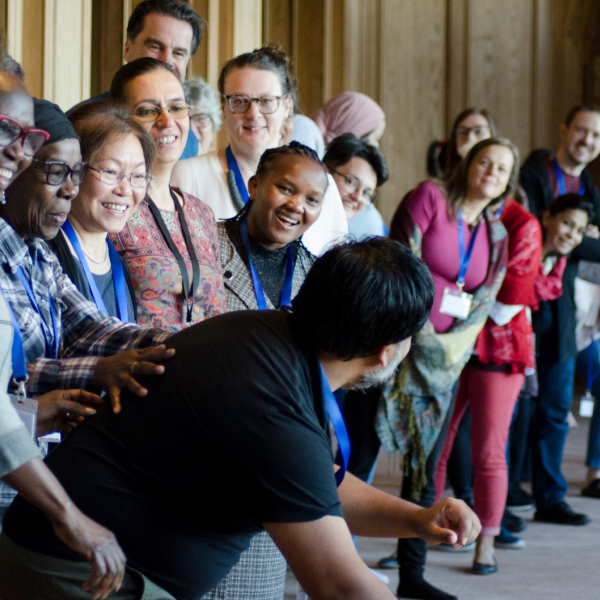
The sun is slowly setting but the air is still warm as ten people form a circle to listen to Brian Iselin’s captivating story told during the human library as part of the Ethical Leadership in Business conference. He tells us how he discovered the extent of modern slavery and how he decided to fight it.
He first came into contact with human trafficking during his time as a federal agent combatting narco-trafficking. While searching for narcotics, he found two baby girls in a sports bag who were meant to be sold for adoption in Vietnam. Profoundly appalled by this discovery he shifted his priority to modern slavery and decided to take action.
But what is modern slavery? Slavery is not a new problem, the main difference today being that trafficked and abused people are not part of our society as they are not seen. Scandals such as child labour are common amongst big fashion brands but most people distance themselves and continue to buy the clothes. As Iselin says, ‘80% of what we all buy is slave tainted (…) we are talking about hundreds of millions of people’.
Two years ago, Iselin created the NGO Slavefreetrade based on his belief about customers that ‘nobody would willingly do something wrong if [they] knew that it was not right’. The aim is to show the customer what they should do instead of blaming them for doing what they should not and therefore relies on a positive message and incentive.
In practice this means that on a regular basis Slavefreetrade asks workers at every stage in a brand’s supply chain if their human rights are being resepcted. The questions include rights such as dignity, equality and child-free labour. Slavefreetrade then provides the company with access to the results so that they can address any issues. Iselin told us about one case in which the head of human resources for a big label discovered that sexual harassment was happening in a factory that he did not even know existed. With the help of this detailed information, he could do something about it.
The platform brings transparency in a sector where it formerly did not exist. The challenge is now to convince big brands to join the movement and face what is really happening in their supply chains. This will only happen by ‘bringing good actors together’.
Would you like to share your inspiration, ideas, and skills with other participants at the Caux IDG Forum this summer on the theme “The Alchemy of Forgiveness”? We look forward to receiving your appli...
À l’occasion de la Journée internationale de la justice sociale, et dans le prolongement d’échanges récents à Caux avec des responsables d’entreprises, Ignacio Packer, directeur exécutif de la Fondati...
After participating in the World Economic Forum Annual Meeting in Davos on 22 January 2026, Ignacio Packer, Executive Director of the Caux Initiatives of Change Foundation, reflects on the question th...
Discover the full report of the Caux Democracy Forum 2025 which brought together more than 350 participants from over 45 countries at the Caux Palace to reflect and act on the theme “Revitalizing Demo...
Call for workshops! You would like to give share your inspiration, ideas and skills with other participants at the Caux IDG Forum this summer? We look forward to your application! Applications will be...
On 25 October 2024, the Caux Round Table (CRT) - Japan hosted the 13th Business and Human Rights Conference in Tokyo with 225 corporate leaders, executives and experts from several Asian countries par...
"In a democracy, each of us carries the responsibility to engage, listen and to contribute. It is more than a political system. It is about choice and voice. How does this resonate with you?" With the...
Spanish journalist Victoria Martín de la Torre is passionate about Europe, diversity and interfaith relations. Here she reflects on different aspects of Europe, based on her PhD research which led her...
Amid escalating conflicts worldwide, the arts emerge as a potent force to challenge misconceptions and foster positive perspectives. The pivotal role of artists in creatively raising awareness has nev...
On 25 - 28 January, some 60 CEOs and other senior staff came together under Chatham House Rules to share personal experiences on how to balance a sustainable business with integrity and trust. Executi...
Save the date for the Caux Forum 2024! This summer Caux Initiatives of Change, in partnership with Initiatives of Change International and supported by other civil society networks, UN agencies, phila...
The Caux Forum 2023 Opening Ceremony set the tone for the conference with the theme, ‘Strengthening Democracy: The Journey from Trauma to Trust.’. Discover the report and relive the highlights of this...
In a world filled with diverse cultures and languages, the journey of musician Tsvetana Petrushina is an inspiring tale of how she discovered her purpose. Her remarkable story led her to the Caux Pala...
Arpan Yagnik, a participant of last year's Creative Leadership conference and team member of the IofC Hub 2021, talks to Mary Lean about creativity, fear and vocation. ...
Bram Jonker is involved in bringing innovation and technology to the digital transformation within Deloitte Tax & Legal. It may be his first time at the Caux Forum but he is no stranger to the Caux Palace where he studied as a student of the Swiss Hotel Management School. He found the Ethical Leadership in Business conference, during which he was a speaker, an enriching experience. ‘It is really about listening, no judgements, no right or wrong answers. It is a safe environment where people can share what they truly believe.’ Bram, for example, has a lot to share about the impact of technology on children now and in the future.
For him, technology is like the water in a bathtub. ‘When parents put their children in the bathtub they first have to check the temperature of the water.’ Parents have the same responsibility when it comes to checking the technology their children use. This is why Bram tests every gadget himself before giving it to his children. If he feels that he cannot trust it, he will search for an alternative.
Bram is convinced that technology will evolve in a way that helps children. For example, when a child asks the virtual assistant what the weather is like instead of simply giving the answer, it could take a more educational approach and explain how to look at the clouds. However, evolution takes time. ‘Until [the technology] is ready, people have to take responsibility. We are not victims; we are making choices.’
Bram believes that ‘jobs remain, tasks shift’ and as a result automatization will be a great opportunity for future generations. Indeed, repetitive tasks are slowly disappearing and being replaced by work involving creativity, collaboration, communication and critical thinking. As robots take care of the boring tasks, more time is freed for meaningful human activities and interaction.
During the conference Bram shared these insights with a wide range of people, who might give him a new perspective about the role technology will play in his children’s life.
As he says,‘I have never been in such a diverse group of people, with different positions in governmental agencies, non-profit organisations but also in the commercial industries and it is very interesting to hear their different points of view.’
Would you like to share your inspiration, ideas, and skills with other participants at the Caux IDG Forum this summer on the theme “The Alchemy of Forgiveness”? We look forward to receiving your appli...
À l’occasion de la Journée internationale de la justice sociale, et dans le prolongement d’échanges récents à Caux avec des responsables d’entreprises, Ignacio Packer, directeur exécutif de la Fondati...
After participating in the World Economic Forum Annual Meeting in Davos on 22 January 2026, Ignacio Packer, Executive Director of the Caux Initiatives of Change Foundation, reflects on the question th...
Discover the full report of the Caux Democracy Forum 2025 which brought together more than 350 participants from over 45 countries at the Caux Palace to reflect and act on the theme “Revitalizing Demo...
Call for workshops! You would like to give share your inspiration, ideas and skills with other participants at the Caux IDG Forum this summer? We look forward to your application! Applications will be...
On 25 October 2024, the Caux Round Table (CRT) - Japan hosted the 13th Business and Human Rights Conference in Tokyo with 225 corporate leaders, executives and experts from several Asian countries par...
"In a democracy, each of us carries the responsibility to engage, listen and to contribute. It is more than a political system. It is about choice and voice. How does this resonate with you?" With the...
Spanish journalist Victoria Martín de la Torre is passionate about Europe, diversity and interfaith relations. Here she reflects on different aspects of Europe, based on her PhD research which led her...
Amid escalating conflicts worldwide, the arts emerge as a potent force to challenge misconceptions and foster positive perspectives. The pivotal role of artists in creatively raising awareness has nev...
On 25 - 28 January, some 60 CEOs and other senior staff came together under Chatham House Rules to share personal experiences on how to balance a sustainable business with integrity and trust. Executi...
Save the date for the Caux Forum 2024! This summer Caux Initiatives of Change, in partnership with Initiatives of Change International and supported by other civil society networks, UN agencies, phila...
The Caux Forum 2023 Opening Ceremony set the tone for the conference with the theme, ‘Strengthening Democracy: The Journey from Trauma to Trust.’. Discover the report and relive the highlights of this...
In a world filled with diverse cultures and languages, the journey of musician Tsvetana Petrushina is an inspiring tale of how she discovered her purpose. Her remarkable story led her to the Caux Pala...
Arpan Yagnik, a participant of last year's Creative Leadership conference and team member of the IofC Hub 2021, talks to Mary Lean about creativity, fear and vocation. ...
Trustbuilding: the critical factor for sustainable peace
11/07/2019
Featured Story
Off
Trustbuilding: the critical factor for sustainable peace
This year’s Just Governance for Human Security conference, part of the Caux Forum, focused on good governance, social inclusion and healing memory. These three human security pillars were linked to the following Sustainable Development Goals: Reduced Inequalities, Gender Equality, and Partnership for the Goals. The participants represented many countries, notably Mali with a delegation supported by the FDFA, Ukraine and Japan. Over the course of five days they were inspired by the panels, equipped through workshops and training tracks, connected during their community groups and reflected in the quiet times. Dominique de Buman, former president of the Swiss National Council, opened the conference on Tuesday 2 July.
‘People that attain a state of good inner governance trust themselves and trust is a natural outcome of good inner governance’ said Iqbal Singh Bains
The panel on 3 July focused on good governance.Iqbal Singh Bains from the Ministry of Happiness, in Madhya Pradesh, India talked about inner governance as a level of wellbeing. With the help of Initiatives of Change, he has set up a happiness programme based on gratitude, responsibility, acceptance and forgiveness.
Dr Christiane Agboston Johnson from the Centre de Hautes Etudes de Défense et de Sécurité, pointed out that women often do not trust the armed security forces and that in order to tackle this strong women are needed in leading positions. Dr Achim Wennmann, Executive Coordinator of the Geneva Peacebuilding Platform, and Jonathan Rudy, from the Alliance for Peacebuilding, spoke about the importance of dialogue between individuals in conflict in order to foster understanding and trust.
The theme of the interactive session on the third day was social inclusion as a condition for trustbuilding with a focus on women, indigenous communities and youth. The first speaker, Nicole Pitter Patterson, Co-Founder of SheLeadsIt spoke about how her organization empowers girls to create apps and podcasts, and to take part in hackathons so they too can be part of the technological revolution while Md Mozahidul Islam, from Rights-based Programming and Advocacy for HEKS/EPER Bangladesh, spoke about the importance of protecting marginalised communities such as indigenous people. Finally, Tinotenda Mhungu, a social and economic justice activist from Zimbabwe, explained how and why he strengthens youth participation in politics.
The plenary on 5 July focused on healing memory as a condition for a peaceful common future. For this to be possible, equitable justice for all, safe spaces for voices to be heard, and a collective and common memory are necessary. Sunny Mawiong, one of IofC India’s young leaders, grew up in a racist environment and talked about his inner transformation. He rid himself of his deep bitterness through reflection during an IofC India programme. He discovered the importance of ‘being open to forgive but also to seeing forgiveness’. Laurent Munyandilikirwa, a human rights defender, talked about the spiral of conflicts in the Great Lake Region. This is caused by a lack of justice as the perpetrators have only partly been judged.
When not in a plenary the participants took part in training tracks and workshops each with a different focus, for example, how to use Forum Theatre to reduce inequalities. The six workshops gave participants a deeper understanding of human security. In one workshop Jonathan Rudy explained how the multi-stakeholder process sparks collaborative action and includes civil society. In another, Hiroshi Ishida, Executive Director of the Caux Round Table, gave an interactive demonstration of Japan’s alternative leadership approach which leaves space for incompleteness. Thanks to a group of experts from various African countries, participants were also able to hear an overview of the governance situation in Africa.
As the conference progressed the participants began to realize that their country was not the only one having problems and that everyone has stories of pain and stories of success to tell. Attending the workshops and talking to each other has given them the energy and motivation to tackle the issues they face. With this renewed vigour, actions will undoubtedly be taken once the participants get home, starting with them sharing with their communities the tools they learned during the Forum.
Furthermore, several ideas for projects emerged during the five days. With the insight that exclusion leads to extremism, one participant wants to create a programme to tackle exclusion in central Africa. Another, having connected with Muslims during the Forum, will seek to bring Muslims and Christians together in his community in the UK. Finally, Ishida will organise exchanges abroad to teach Japanese children about the importance of diversity. These ideas and projects aim to enhance trust in the participating communities to in turn create good governance, heal memories and foster social inclusion.
On Thursday 4 July at the Caux Forum I met a group of four women involved in the peace circles in Mali: Boye Diallo, Mamou Soucko, Kadidia Djenepo and Kadidiatou Mint Hanka. Peace circles is a project...
Londoner Jonas Truneh (25) and I are sitting on a bench, watching participants in the Caux Scholars and Caux Peace and Leadership (CPLP) programmes playing something resembling football. As he deflect...
A call to action has been sounded for global citizens to stand up and take responsibility in addressing the social and economic issues which threaten communities worldwide by working together to achie...
Raghad Al Saadi was one of this year’s speakers at the Just Governance for Human Security conference. Raghad and her family were displaced by the different armed conflicts in her home country, Iraq. W...
In July 2018, for the second year running, the humanSecurityX certificate track programme ran in parallel to the forum on Just Governance for Human Security (JGHS). Its core aim: for participants to g...
Seven years ago, Shalisa Hayes’s son, Billy Ray, was shot in cross-fire while attending a party with his friends in Tacoma, a city south of Seattle, USA. Shalisa reacted to this tragedy by creating a ...
Wounds inflicted upon generations past and present across the globe cannot be overlooked. They leave their scars and often remain unhealed, perpetuating conflict. More than ever, healing is needed to ...
The first women's retreat organized by the Just Governance for Human Security (JGHS) team focused on women as drivers towards positive change in their communities. Fifteen women attended the retreat, ...
For the second year in a row, 14 people from Tulsa, Oklahoma (USA) came to the Caux Forum to hold a dialogue on healing the wounds of the past and working for better race relations in their community,...
When Christian Picciolini joined the white supremacist skinhead movement at the age of 14, he never would have imagined that he would grow up to reverse what he had helped build in the 1980s and 1990s...
‘For anyone taking human security seriously, it’s a vital necessity to oppose and reject the inevitability of war,’ said Pierre Krähenbühl, Commissioner-General for UNRWA (the UN Relief and Works agen...
During the final morning plenary of the Just Governance for Human Security Conference in July, participants were presented with a 90-day action challenge. Members of a delegation from Tulsa, Oklahoma,...
By Antoine Jaulmes, Council Member of IofC Switzerland
06/07/2019
Featured Story
Off
By Antoine Jaulmes, Council Member of IofC Switzerland
The Caux Conference and Seminar Centre already saves energy in many ways. It has also installed wood-chip fuelled heaters, which use local resources rather than importing oil. Now Caux is becoming even greener.
Initiatives of Change (IofC) Switzerland will offset the carbon footprint of the 2019 Caux Forum by planting 2,000 rubber trees in Meghalaya. (You can contribute your share if you wish – it’s just a few francs per person).
IofC wants to take full responsibility for the CO2 emissions it generates. Just running the Caux Conference and Seminar Centre emits about 160 kg of CO2 per person per day. The Caux Forum also contributes to global warming by encouraging travel. The average participant will send 1,400 kg of CO2 into the atmosphere – though, of course, an individual’s contribution can vary between as much as 6,700 kg for those who fly long distances to under 10 kg for those who travel by regional train.
In total, the Caux Forum 2019 will be responsible for some 1,900 tons of carbon emissions. To compensate for this, 2,000 rubber trees which will be planted in Meghalaya, a state of North-East India which has had a longstanding relationship with IofC since the 1960s.
The trees will be planted by the Worldview Impact Foundation, which uses drones to plant seeds in the cloud forests of Meghalaya and the mangrove forests of south-west Myanmar.
Worldview Impact’s founder and Chief Executive, Dr Bremley WB Lyngdoh has a long family connection with IofC. In the late Sixties, when Meghalaya was seeking independence from the state of Assam, Bremley’s great-uncle BB Lyngdoh went to Asia Plateau, IofC’s conference centre in Panchgani, India, to have frank discussions with other political leaders. At the same time, Bremley’s father, Eric B Lyngdoh, led young volunteers into the non-violent Hill State Movement, following IofC principles and convincing Assam’s political leaders to allow the birth of Meghalaya without bloodshed. And more recently Bremley himself helped to organize an international conference for IofC in Shillong, Meghalaya’s capital.
Bremley Lyngdoh came to Caux in 2017 and 2018 to participate in the Caux Dialogue on Land and Security (CDLS). He came back for this year’s CDLS in late June with Conrad Sangma, Chief Minister of Meghalaya. They welcomed IofC’s help with their initiatives to restore fragile cloud forest and mangrove ecosystems.
Would you like to share your inspiration, ideas, and skills with other participants at the Caux IDG Forum this summer on the theme “The Alchemy of Forgiveness”? We look forward to receiving your appli...
After participating in the World Economic Forum Annual Meeting in Davos on 22 January 2026, Ignacio Packer, Executive Director of the Caux Initiatives of Change Foundation, reflects on the question th...
Discover the full report of the Caux Democracy Forum 2025 which brought together more than 350 participants from over 45 countries at the Caux Palace to reflect and act on the theme “Revitalizing Demo...
Call for workshops! You would like to give share your inspiration, ideas and skills with other participants at the Caux IDG Forum this summer? We look forward to your application! Applications will be...
"In a democracy, each of us carries the responsibility to engage, listen and to contribute. It is more than a political system. It is about choice and voice. How does this resonate with you?" With the...
Spanish journalist Victoria Martín de la Torre is passionate about Europe, diversity and interfaith relations. Here she reflects on different aspects of Europe, based on her PhD research which led her...
Amid escalating conflicts worldwide, the arts emerge as a potent force to challenge misconceptions and foster positive perspectives. The pivotal role of artists in creatively raising awareness has nev...
On 25 - 28 January, some 60 CEOs and other senior staff came together under Chatham House Rules to share personal experiences on how to balance a sustainable business with integrity and trust. Executi...
Save the date for the Caux Forum 2024! This summer Caux Initiatives of Change, in partnership with Initiatives of Change International and supported by other civil society networks, UN agencies, phila...
The Caux Forum 2023 Opening Ceremony set the tone for the conference with the theme, ‘Strengthening Democracy: The Journey from Trauma to Trust.’. Discover the report and relive the highlights of this...
In a world filled with diverse cultures and languages, the journey of musician Tsvetana Petrushina is an inspiring tale of how she discovered her purpose. Her remarkable story led her to the Caux Pala...
Arpan Yagnik, a participant of last year's Creative Leadership conference and team member of the IofC Hub 2021, talks to Mary Lean about creativity, fear and vocation. ...
When Indonesian law student Agustina Zahrotul Jannah discovered the Young Ambassadors Programme (YAP) on Google she felt both excited and hopeless: excited because she hoped it might give her the skil...
How did Sofia Syodorenko become involved in the zero waste movement, and what does it mean to her? Now Chair of Foundations for Freedom, she is also a representative of the Zero Waste Alliance Ukraine...
Jens J Wilhelmsen is Norwegian and he fought in the clandestine resistance movement to liberate his country from foreign occupation. After the war, he had the unique experience of spending a decade in two of the countries which lost, in Germany from 1948 to 1953, and in Japan from 1953 to 1958. In both countries he worked with IofC, and distilled his experience in two books: 'Men and Structure' (1982) and 'Eyewitness to the impossible' (2016).
The Caux Forum 2019 kicked off last week with the Ethical Leadership in Business (ELB) conference which ran in parallel with the Caux Dialogue on Land and Security. The Ethical Leadership in Business conference took place from 27-30 June and centred on 'Rethinking trust in the digital age’.
Day 1
Amandeep Singh Gill, India's Ambassador and Permanent Representative to the Conference on Disarmament in Geneva, opened the conference by sharing some conclusions of the High-Level Panel on Digital Cooperation, whose secretariat he heads. The panel’s report, The Age of Digital Interdependence, indicates that the opportunities for human progress in the digital age ultimately outweigh the challenges – if we join together in a spirit of cooperation and inclusiveness. The report identifies good examples of cooperation across sectors, disciplines and borders to address challenges in the digital age, and makes proposals for the way forward.
Fr Eric Salobir, Founder and President of Optic Technology, took the group on a digital adventure, to explore what daily life might be like in an increasingly tec-heavy world. His scenarios pointed to the potential dark sides of over-reliance on smart phones, watches, devices and AI. He encouraged participants to trust in the resilience of humanity.
Day 2
The morning’s panel discussion asked ‘Will technology improve digital trust?‘. Click here and watch the whole session on our Facebook page.
Anne-Catherine Melnotte, from Firmenich, the world’s largest privately-owned fragrance and flavour company, underscored the need to be clear on what data is collected and for what purposes.
Jowan Österlund, CEO of Biohax International, talked about Blockchain solutions which enable individuals to own and, potentially, monetize their own data.
Sébastien Fabre rom SITA, the world's leading air transport IT and communications specialist, spoke of the need for frameworks to enable individuals to manage their data and options. He said that regulation is evolving and cited the example of San Francisco, where a local ordinance prohibits the use of facial recognition technology by city departments and requires them to seek approval before deploying any other new kind of surveillance technology.
Susanne Emonet, a Vice President at the Kudelski Group, talked of the risks to people in the new digital world. She pointed out that everything was hackable, from the connected hoover at home to the national power grid. Her company is a global leader in digital security and convergent media solutions and is based in Switzerland. Education and understanding are needed to build trust, she said, and to increase cybersecurity standards. People don't often know where data goes and where it is being collected and stored; they need to be more aware of how their devices expose them.
The afternoon’s Tech & Trust Talk featured Kaspar Kork from the Estonian Investment Agency and Marylaure Bloch from Optic Technology and the University of Geneva. They spoke about the digital culture in Estonia and China. For example, the Chinese government is developing the 'social credit system' to standardize assessment of citizens' and businesses' economic and social reputation. The system uses big data analysis technology and can be seen as a form of mass surveillance. Its accuracy is not 100 per cent and a uniform national system is not yet fully in place.
Estonia is known as a ‘cool and digital society’, said Kaspar Kork. Electronic ID cards are used for various government services. People trust the government and believe that their data is secure thanks to the decentralization of data, high security and protective legislation. The system eases registering companies and doing business at home and abroad. Estonia’s e-residency system allows citizens to use services wherever they are located in the world. All personal data is available to and controllable by the individual. Estonia was first country to use Blockchain on a national level. (e-Residency is a government-issued digital identity and status that provides non residentials access to Estonia’s government services).
The Human Library in the evening gave participants a chance to hear individual stories shared in depth. Brian Iselin gave gripping accounts of human rights violations that his organization slavefreetrade has uncovered in their pursuit of ethical consumerism. Suat Topsu, the President of SATT IDF Innov, described how he co-invented LIFI, a revolutionary wireless technology that uses LED light sources instead of microwaves to transmit data.
Day 3
The morning plenary opened with the question: ‘Will the digital transformation humanize work?’
The panel included Peace Kuteesa from Uganda, the founder of Zimba Women. She spoke about what she has learnt through coaching and working with women who are building their own businesses. (Zimba means to build.) She talked about empowerment, the fears that prevent women from doing their best and the cultural elements that can sometimes slow women down (for instance, male-dominated households where women have to ask permission to access the computer or are not supposed to speak out).
Bram Jonker from Deloitte (Netherlands) shared his belief that automation can free people to do more human-related work. He referenced Future of the Professions by Richard and Daniel Susskind, which predicts the decline of today's professions and describes the people and systems that will replace them. He sees robots 'partnering' with humans even more in the future as repetitive and manual tasks are automated. AI will provide things we couldn't possibly do.
The afternoon session on ‘New professions bring new opportunities and responsibilities’, featured Morgan Gray, who leads Global Digital Listening and Insights at Corteva Agriscience (the agricultural division of DowDuPont). Her role includes finding, tracking and analyzing social media conversations with the aim of bringing public discourse into the company. She works with digital tools and AI to monitor online conversations, analyze data and identify key themes for her company.
Carolyn Moncel is Senior Communications Manager with the Geneva Centre for Security Policy (GCSP), an international foundation that promotes peace, security and stability. She said her role is all about 'digital amplifying’, working with teams to align content (video, web, social media, etc) within their communication channels. She challenged people go into the unknown and see where it leads them. Women are often scared away from IT by the assumption that it requires a high level of digital skill. She urged both young and old to stay open and keep learning, in the belief that there will be jobs for those who keep their skills updated.
Watch an online interview of Carolyn Moncel and Morgan Gray by Rainer Gude, IofC Switzerland.
Day 4
ELB concluded with a silent 'mindful' walk to a tranquil meeting point with scenic views to Lake Geneva. During the ascent, participants were invited to reflect on what they had learned at the conference, both professionally and in terms of personal purpose, values, change and choices. They were also encouraged to define next steps and commitments. In doing this they could draw on the daily Trust Incubator session, led by Tom Marshall from Deloitte (Netherlands), which helped participants generate ideas, insights and tools and to reflect on their purpose and values.
Four key projects emerged for implementation the coming year. Teams were established and first steps were defined:
1. The creation of a platform, where participants can keep connected, share projects, discuss issues and produce a digital newsletter.
2. A bi-monthly conference call to share knowledge and skills and to encourage a continuous learning mindset.
3. A monthly open call to address themes raised by the platform team.
The Ethical Leadership in Business conference equipped me with the mindset, knowledge and connections to contribute to ensuring that our digital transformation benefits humankind. Tom Marshall, Innovation Community Ambassador, Deloitte (Netherlands)
Caux is such a humbling place, providing you with a safe space to experiment with different topics and flourish in bold-thinking, all while staying true to yourself. Michelle Rickenbach, IT Project Management & Ecosystem Relations at Panter AG
À l’occasion de la Journée internationale de la justice sociale, et dans le prolongement d’échanges récents à Caux avec des responsables d’entreprises, Ignacio Packer, directeur exécutif de la Fondati...
On 25 October 2024, the Caux Round Table (CRT) - Japan hosted the 13th Business and Human Rights Conference in Tokyo with 225 corporate leaders, executives and experts from several Asian countries par...
Annika Hartmann de Meuron, Managing Director of Ethical Leadership in Business (ELB), looks back on four exciting years of developing ethical leadership in business in Switzerland. ELB aimed to increa...
The Co-founder of Zimba Women, Peace Kuteesa, is passionate about providing women with the tools and resources to participate in their economies and develop their communities. She spoke at last year's...
A year ago, video conferencing became the new normal in our work lives. It was the safest place for us to meet and collaborate. It seemed so easy: just invite someone to join the call and continue as...
Global Entrepreneurship Week in November 2020 included e-space, a three-day hybrid event, which offered a range of master classes and conferences. Rainer Gude, Co-Director General of Initiatives of Ch...
During Global Entrepreneurship Week in November 2020, Initiatives of Change Switzerland took part in e-space, a three-day hybrid event, which offered a range of master classes and conferences. Annika ...
The Ethical Leadership in Business conference, on 25 and 26 June 2020, kicked off the first Caux Forum Online. It offered a diversified experience with panels livestreamed from the Caux Palace, networ...
Nazrene Mannie is the Executive Director of the Global Apprenticeship Network (GAN) and talks about her learning experiences. Our interview series 'My Learning Story’ hopes to become a global learning...
Our interview series ‘My Learning Story’ hopes to become a global learning experience, connecting people around the world as they share their stories of what we all do every day: learning to build a b...
‘My Learning Story’ hopes to become a global learning experience, connecting people around the world as they share their stories of what we all do every day: learning to build a brighter future. Disco...
Our new feature ‘My Learning Story’ hopes to become a global learning experience, connecting people around the world as they share their stories of what we all do every day: learning to build a bright...